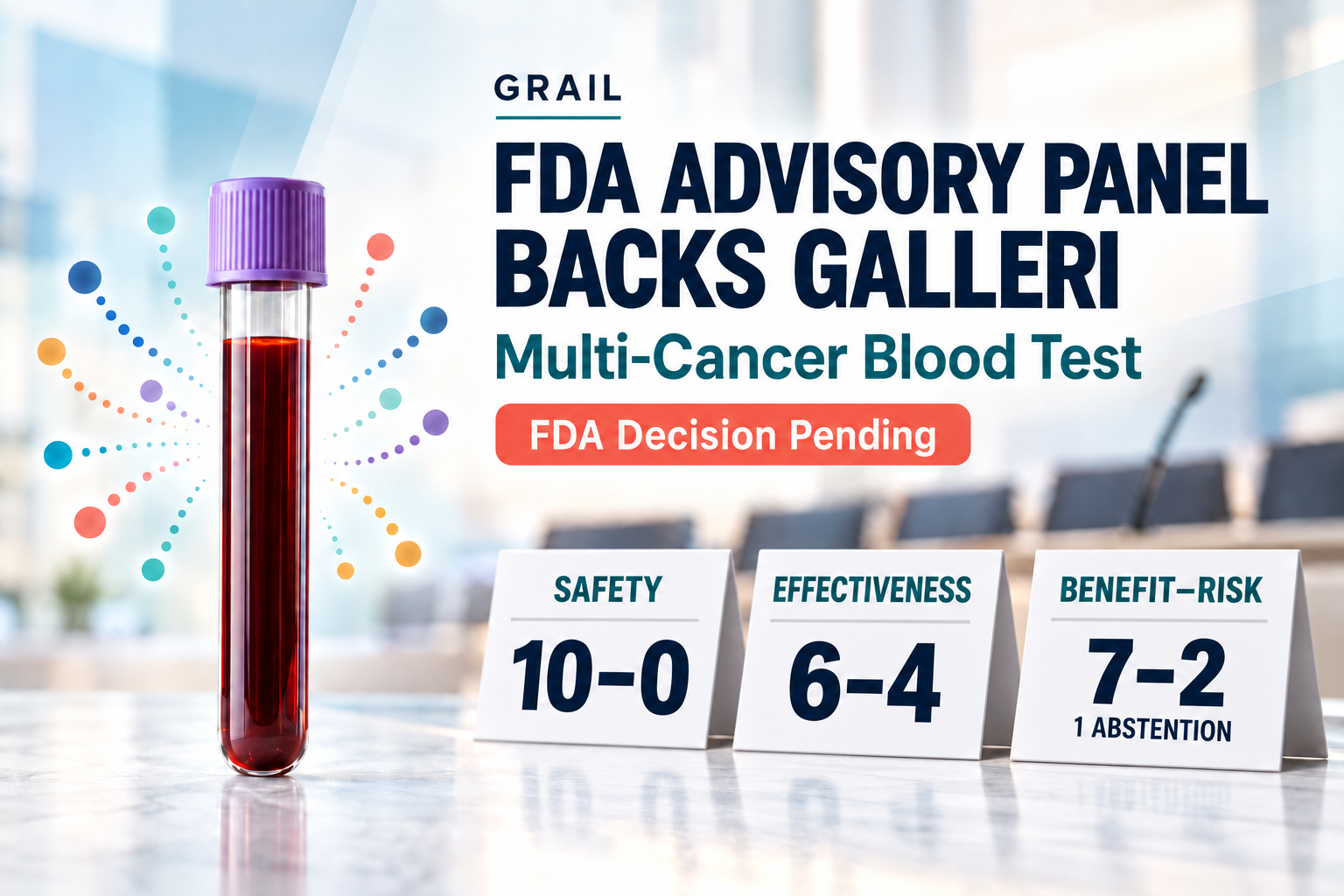
Advisers concluded that Galleri’s benefits outweigh its risks for adults aged 50 and older, but FDA approval remains pending.
Key Takeaways
- The FDA advisory panel voted 7–2, with one abstention, that Galleri’s benefits outweigh its risks.
- Safety received unanimous support, but the 6–4 effectiveness vote showed continued uncertainty about the clinical evidence.
- Galleri is not FDA approved and must be used alongside—not instead of—established cancer screening.
Data Snapshot
| Item | Details |
|---|---|
| Company | GRAIL |
| Test | Galleri |
| Intended population | Adults aged 50 and older |
| Test approach | NGS analysis of cancer-specific cfDNA methylation |
| Safety vote | 10–0 |
| Effectiveness vote | 6–4 |
| Benefit–risk vote | 7–2, with one abstention |
| PATHFINDER 2 performance | 35.0% sensitivity; 99.85% specificity |
| Regulatory status | FDA PMA decision pending |
What Happened: FDA Panel Backs Galleri
On September 23, 2026, the Molecular and Clinical Genetics Panel of the Medical Devices Advisory Committee backed GRAIL’s Galleri multi-cancer early detection blood test.
The panel unanimously supported Galleri’s safety and concluded that its benefits outweigh its risks. However, the narrow effectiveness vote showed that several panelists remained unconvinced by the strength of the evidence.
GRAIL submitted its Premarket Approval (PMA) application on January 29, 2026. The company expects a final decision in the coming months, but FDA has not disclosed a formal decision date. The panel’s recommendation is non-binding and does not constitute FDA approval. (GRAIL announcement)

Why It Matters: Strong Specificity, Limited Sensitivity
Galleri uses next-generation sequencing to detect cancer-specific methylation patterns in cell-free DNA from blood. When it finds a cancer signal, the test also predicts its likely origin to guide diagnostic follow-up.
In PATHFINDER 2, Galleri showed 35.0% sensitivity and 99.85% specificity over 12 months. The high specificity limits false-positive results, but the sensitivity result means the test missed most cancers diagnosed during follow-up.
An important limitation is that PATHFINDER 2 and NHS-Galleri prospectively used an earlier test version called MCED-V2. Performance of the PMA-submitted Galleri version was assessed retrospectively using stored samples and a bridging analysis. (FDA executive summary)
The three-year NHS-Galleri trial also did not significantly reduce late-stage cancer diagnoses overall. Galleri must therefore supplement—not replace—mammograms, colonoscopies and other recommended screening. A negative result cannot rule out cancer. (Reuters)
BP View
If approved, Galleri would become the first FDA-approved multi-cancer early detection test and gain a regulatory advantage over competing tests such as Abbott’s Cancerguard.
The favorable panel vote improves Galleri’s approval outlook, but approval alone will not secure broad adoption. GRAIL must still show that detecting additional cancer signals leads to better patient outcomes, guideline inclusion and reimbursement. (Reuters)

Related Post
For another example of blood-based diagnostics moving into clinical practice, read my previous analysis:
Roche and Eli Lilly Win FDA Clearance for Alzheimer’s Blood Test
About BP
Biopharma Perspective provides independent analysis of pharmaceutical and biotechnology news, connecting clinical evidence, regulatory decisions and market strategy.

Leave a Reply