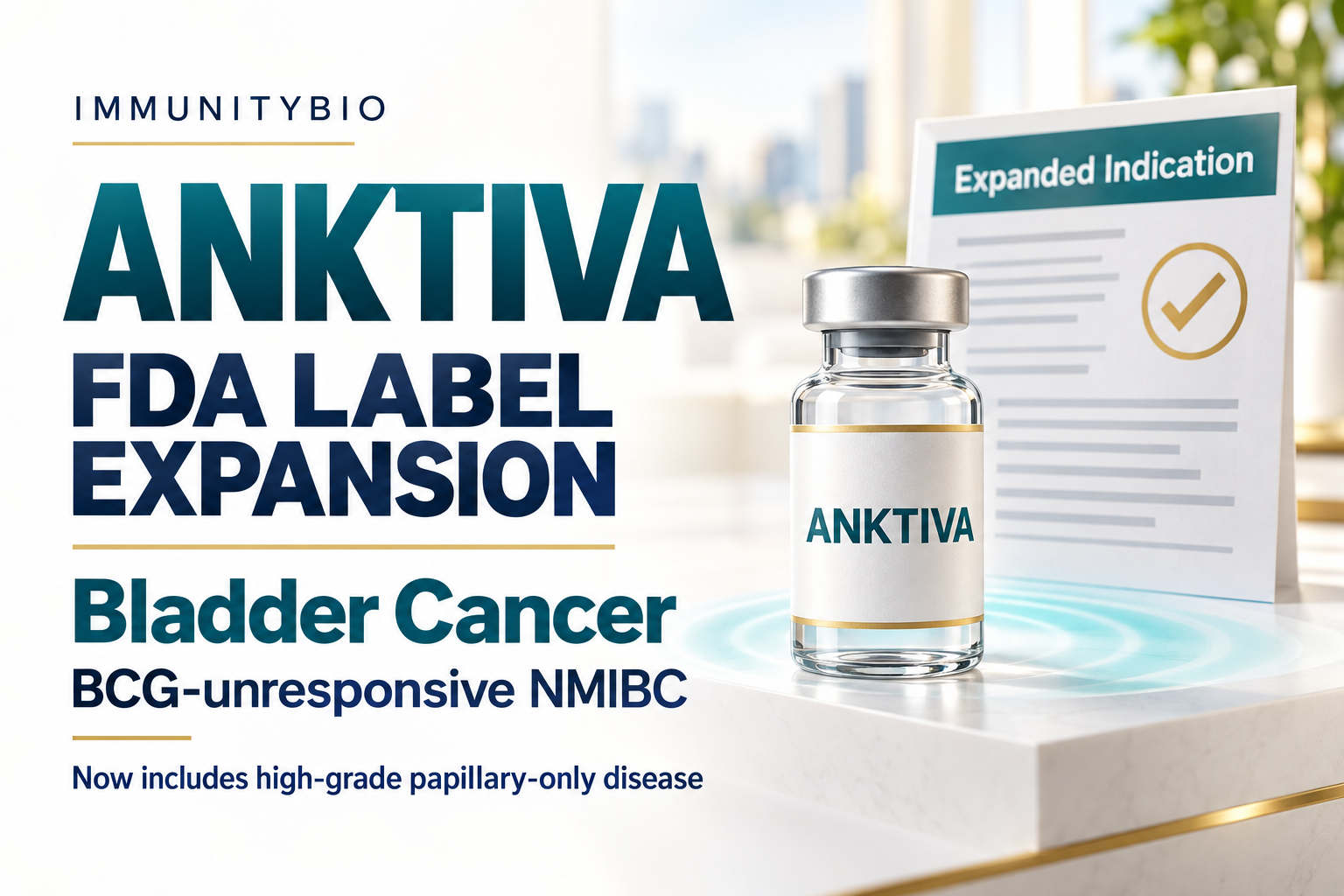
The approval adds high-grade papillary-only disease, extending existing efficacy evidence across closely related forms of BCG-unresponsive bladder cancer.
Key Takeaways
- On October 14, 2026, the FDA expanded Anktiva plus BCG to adults with BCG-unresponsive, high-grade papillary-only non-muscle-invasive bladder cancer.
- The decision extrapolates efficacy established in patients with carcinoma in situ to this related disease subtype.
- Anktiva stimulates IL-15 receptors to expand and activate immune cells. Broader adoption will depend on disease control, tolerability and treatment delivery.
Data Snapshot
| Item | Details |
|---|---|
| Company | ImmunityBio |
| Drug | Anktiva (nogapendekin alfa inbakicept-pmln) |
| FDA approval date | October 14, 2026 |
| Newly included population | Adults with BCG-unresponsive, high-grade papillary-only NMIBC |
| Combination partner | Bacillus Calmette–Guérin (BCG) |
| Mechanism | Interleukin-15 receptor agonist |
| Administration | Intravesical instillation |
NMIBC means non-muscle-invasive bladder cancer. The expansion includes high-grade papillary tumors occurring without carcinoma in situ.
What Happened
The U.S. Food and Drug Administration expanded Anktiva’s approval with BCG to include adults with BCG-unresponsive, high-grade papillary-only NMIBC.
Anktiva’s original 2024 approval covered patients with carcinoma in situ (CIS), with or without papillary tumors. The expansion makes Anktiva plus BCG the first FDA-approved treatment specifically for BCG-unresponsive, high-grade papillary-only disease. (FDA approval announcement)
Fierce Pharma reported that the decision arrived nearly three months before the January 6, 2027 target date, following an earlier refusal-to-file. (Fierce Pharma coverage)
Why It Matters
The FDA accepted that efficacy demonstrated in CIS could support approval in high-grade papillary-only disease.
Although the tumors grow differently, the agency identified overlapping clinical and biological features. Both are aggressive urothelial cancers, frequently coexist and carry substantial recurrence and progression risks after BCG failure.
The FDA cited the existing CIS cohort of QUILT-3.032. Among 77 patients, the complete response rate was 62%. Of those who responded, 58% maintained their response for at least 12 months and 40% for at least 24 months. These are CIS-cohort results, not response rates measured in the newly included papillary-only population.
The decision broadens Anktiva’s eligible population and could influence how developers plan studies across related NMIBC subtypes.
Science Brief: How Anktiva Works
Anktiva is an interleukin-15 (IL-15) receptor agonist. Its preassembled protein complex contains two modified IL-15 molecules, each bound to an IL-15 receptor alpha sushi domain linked to an immunoglobulin G1 Fc scaffold.
The receptor fragments hold and present IL-15. The modified IL-15 stimulates the CD122 and CD132 receptor chains on responding immune cells, promoting the proliferation and activation of natural killer (NK) cells, CD8-positive T cells and memory T cells. (FDA prescribing information: structure and mechanism)
BCG triggers a local immune response in the bladder. Anktiva strengthens immune-cell activity within the combination, supporting an enhanced antitumor response. (ImmunityBio mechanism overview)

Anktiva stimulates IL-15 receptors to promote immune-cell proliferation and activation. Conceptual illustration; not to scale.
The Main Risks
The expansion relies on extrapolation from established CIS efficacy. It does not establish superior outcomes over other treatments through a new randomized papillary-only trial.
Treatment requires repeated bladder instillations and surveillance. Common adverse reactions include urinary symptoms, urinary tract infections, fever and laboratory abnormalities. Persistent or progressing disease requires timely reassessment: delaying cystectomy can allow potentially lethal metastatic progression. (FDA efficacy, safety and administration review)
BP View
The commercial test is whether broader eligibility translates into sustained treatment uptake.
Anktiva now has a wider approved role. Its value in practice will depend on durable disease control, tolerability and the demands of repeat administration.
The FDA’s approach also deserves continued attention. The agency is finalizing guidance addressing evidence extrapolation in this setting. Clearer expectations could influence trial design and development spending across NMIBC.
Have questions about the mechanism or a different view on the approval? Leave a comment—I’d welcome your thoughts.

Related Post
IL-15 is also being targeted through inhibition in immune-mediated disease. Read my previous analysis of Teva’s TEV-‘408 Phase 2a results in celiac disease.
About BP
Biopharma Perspective (BP) explains global biopharma news through strategic, scientific and market perspectives.

Leave a Reply