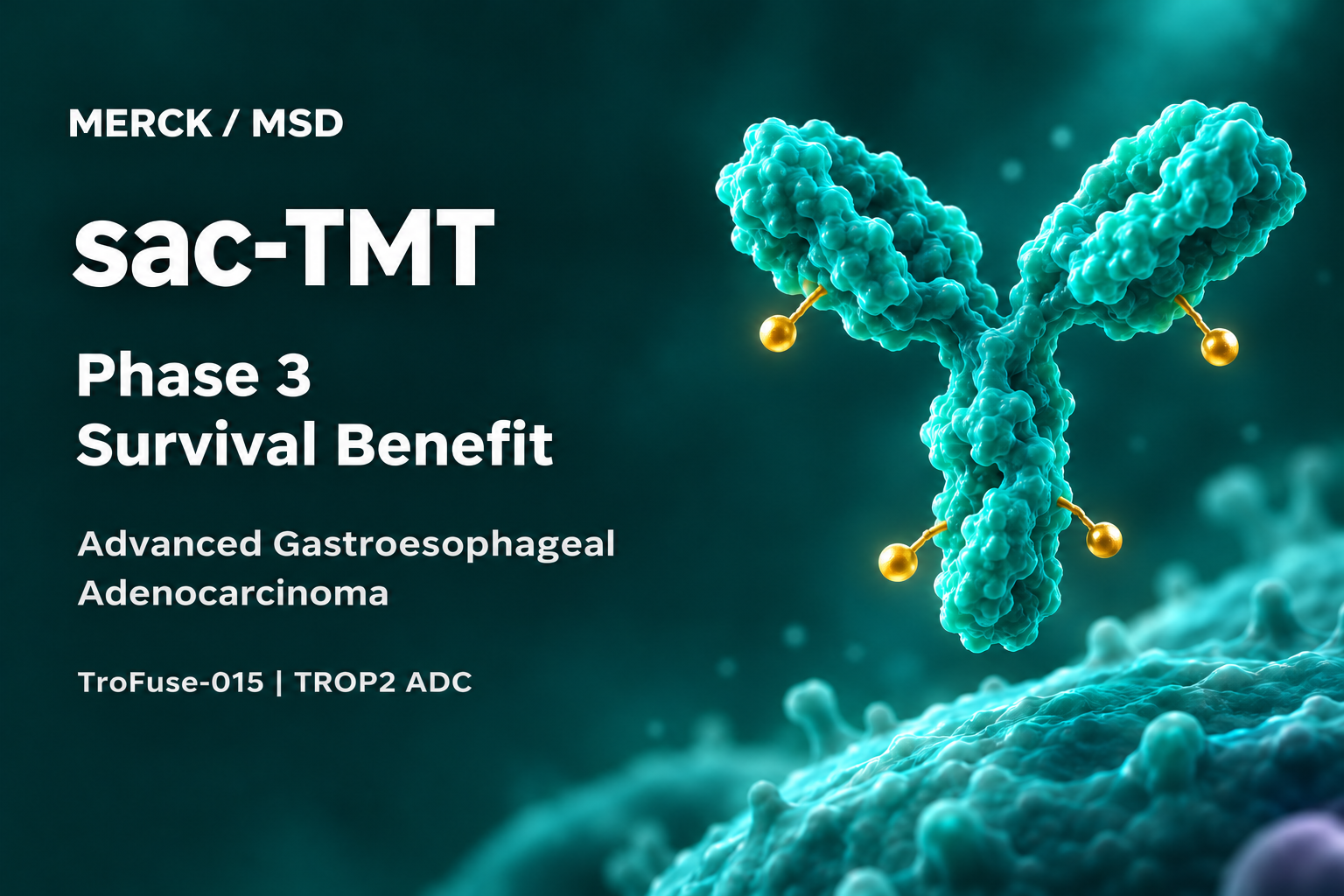
Merck, known as MSD outside the United States and Canada, announced on November 20, 2026, that sacituzumab tirumotecan (sac-TMT) improved overall survival in the Phase 3 TroFuse-015 trial. The TROP2-directed antibody-drug conjugate was evaluated in patients with advanced gastroesophageal adenocarcinoma after at least two previous lines of systemic therapy. (Fierce Biotech’s coverage of the sac-TMT results)
The finding supports a potential additional treatment for patients whose cancer has progressed despite earlier therapies. It represents a clinical development milestone; sac-TMT has not received FDA approval for this indication.
| Item | Details |
|---|---|
| Developers | Kelun-Biotech; Merck holds development and commercial rights outside Greater China |
| Drug | Sacituzumab tirumotecan, or sac-TMT; also called MK-2870/SKB264 |
| Modality | TROP2-directed antibody-drug conjugate |
| Payload | Belotecan-derived topoisomerase I inhibitor |
| Trial population | Unresectable locally advanced or metastatic gastroesophageal adenocarcinoma after at least two prior systemic treatment lines |
| Administration | Intravenous infusion |
| Study | TroFuse-015, Phase 3; NCT06356311; 473 patients |
| Main finding | Overall survival endpoint met; progression-free survival endpoint not met |
Gastroesophageal adenocarcinoma includes cancers arising in the stomach, gastroesophageal junction and esophagus. TroFuse-015 evaluated sac-TMT as third-line or later treatment, following at least two previous systemic treatment regimens. This is a setting in which additional effective options remain important.
Sac-TMT combines an antibody that recognizes TROP2 with a cytotoxic payload attached through a linker. Following cellular uptake and payload release, the topoisomerase I inhibitor interferes with DNA replication and promotes cancer-cell death. (Published sac-TMT research)
Originally developed by Kelun-Biotech, sac-TMT is already approved in China for other indications. The new study examines its potential in a different treatment setting.
What Sac-TMT’s Phase 3 Survival Result Shows
TroFuse-015 was a randomized, open-label, global trial comparing sac-TMT with physician-selected treatment: trifluridine-tipiracil, irinotecan, paclitaxel or docetaxel.
According to Merck, the final analysis demonstrated a statistically significant improvement in overall survival, the primary endpoint. However, the study did not meet its secondary progression-free survival endpoint, assessed by blinded independent central review. Merck plans to present the findings at a medical meeting and share them with regulatory authorities. (Merck’s TroFuse-015 announcement)
Overall survival measures time until death from any cause, while progression-free survival measures time until cancer progression or death. The different outcomes warrant attention, but the announcement does not establish why they diverged.
The company has not disclosed median survival, hazard ratios or detailed adverse-event rates for this trial. Those figures are needed to assess the magnitude of benefit and its balance against treatment risks. Merck reported no new safety signals, which does not mean the treatment was free of side effects.
I welcome the prospect of another treatment for patients whose advanced gastroesophageal cancer has progressed despite earlier therapies. For patients facing limited remaining options and a difficult outlook, a survival benefit is an encouraging development. I support the research behind this potential treatment and hope further evaluation supports FDA approval, bringing another option to patients as soon as possible.
For another recent treatment milestone, read my previous article on Infilbray’s FDA approval for neurological manifestations of Type 3 Gaucher disease.

Leave a Reply