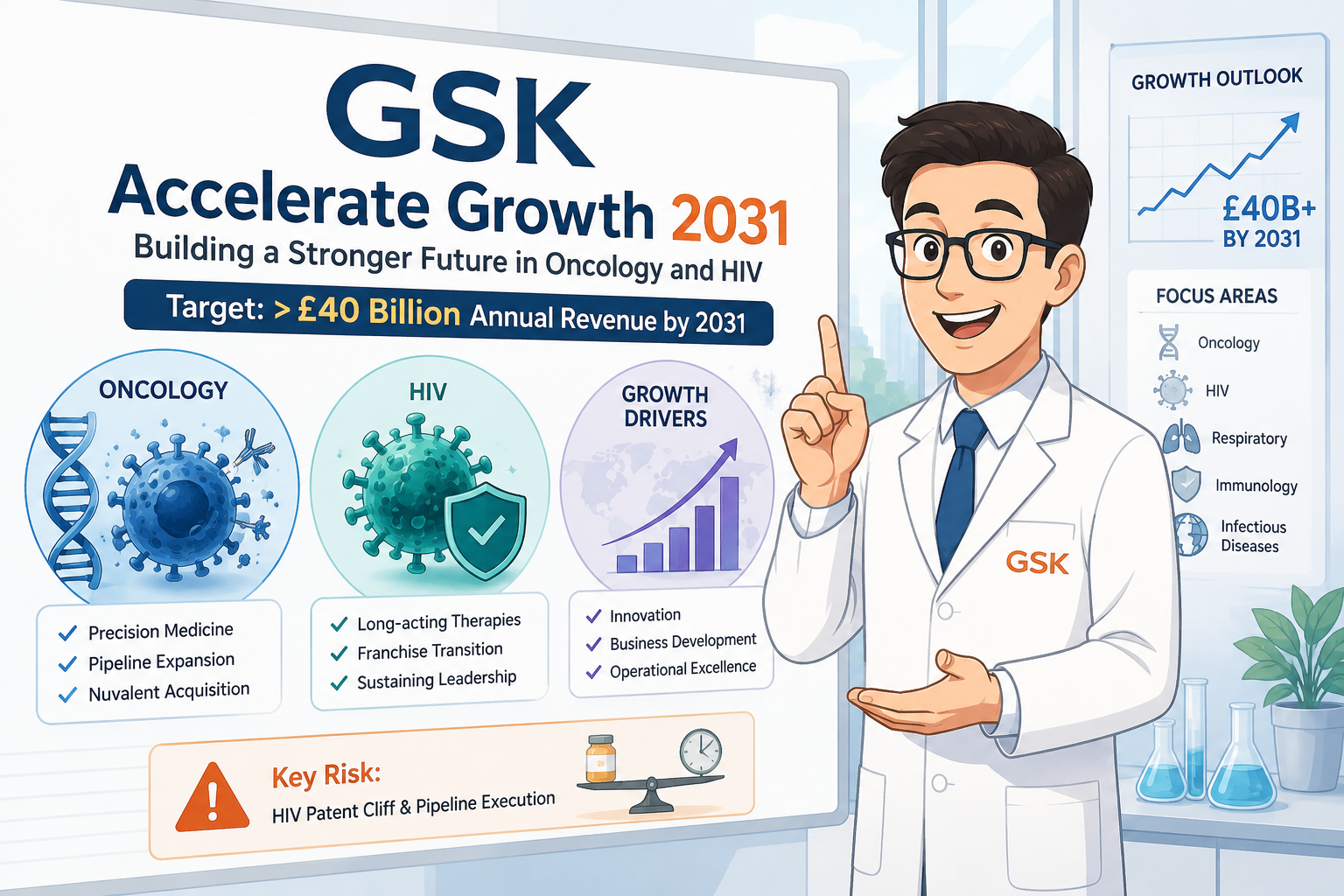
Investors will look beyond GSK’s long-term revenue target as CEO Luke Miels outlines how oncology innovation and HIV transformation are expected to reshape the company’s next phase of growth.
Key Takeaways
- GSK will host its “Accelerate Growth” investor event on July 28 alongside second-quarter earnings, providing its first comprehensive strategic update under CEO Luke Miels.
- Rather than announcing a new financial target, management is expected to explain how oncology, HIV, respiratory and specialty medicine portfolios will support annual revenue exceeding £40 billion by 2031.
- Recent oncology momentum strengthens the growth story, but pipeline execution and the approaching HIV patent cliff remain the company’s biggest long-term challenges.
Data Snapshot
| Metric | Current Position |
|---|---|
| 2025 Revenue | £32.7 billion |
| 2031 Revenue Target | Above £40 billion |
| Oncology Growth (2025) | +43% YoY |
| HIV Revenue (2025) | £7.7 billion |
| Largest Strategic Risk | HIV patent cliff & late-stage pipeline execution |
What Happened
GlaxoSmithKline (GSK) will release its second-quarter financial results on July 28, followed by its Accelerate Growth investor event.
The presentation represents the first major strategic briefing led by CEO Luke Miels, who is expected to explain how GSK intends to achieve its previously announced objective of generating more than £40 billion in annual revenue by 2031.
Rather than introducing a new financial target, investors are likely to focus on the assumptions behind the existing goal.
Management is expected to discuss how oncology, HIV, respiratory disease, immunology and infectious disease franchises will contribute to future growth while also outlining its business development priorities, pipeline investment strategy and long-term capital allocation.
Original Sources
- GSK Investor Relations – Q2 Results & Accelerate Growth Event
- Reuters – GSK eyes sharper, faster drug development as new CEO signals growth plan
- Fierce Biotech – GSK secures first lung cancer approval as FDA clears Jideytro
Why It Matters
GSK enters this strategy update from a position of operational strength, yet faces one of the pharmaceutical industry’s most familiar long-term challenges: replacing revenue from products approaching patent expiration.
The company’s HIV franchise remains one of its largest commercial businesses, generating £7.7 billion in revenue during 2025. However, several key products are expected to face patent expiration later this decade, making lifecycle management increasingly important.
To offset that pressure, GSK has accelerated investment in oncology through both targeted acquisitions and regulatory execution.
The acquisition of Nuvalent expanded the company’s precision oncology pipeline, while the recent FDA approval of Jideytro demonstrated its ability to convert pipeline assets into commercial products.
At the same time, the discontinuation of camlipixant following unsuccessful Phase 3 trials illustrates the uncertainty inherent in late-stage drug development. Even advanced clinical programs with meaningful commercial expectations can fail, reinforcing the need for a diversified portfolio.
Ultimately, GSK’s long-term strategy will be judged not by the ambition of its revenue target, but by its ability to consistently deliver clinical success, regulatory approvals and commercial execution.
Strategic Implications
GSK’s current strategy reflects a broader shift taking place across the global pharmaceutical industry.
Rather than relying primarily on internally discovered medicines, many large pharmaceutical companies are increasingly strengthening their pipelines through acquisitions of late-stage assets that can reach commercialization within a shorter timeframe.
Compared with peers such as Merck & Co., Bristol Myers Squibb, and AstraZeneca, GSK currently operates a relatively smaller oncology business. Instead of attempting to match competitors through large-scale internal research alone, the company has adopted a more focused approach by selectively acquiring high-quality clinical assets capable of accelerating portfolio expansion.
At the same time, maintaining leadership in HIV requires more than protecting existing products. GSK must successfully transition physicians and patients toward next-generation long-acting therapies before generic competition begins eroding revenue from current treatments.
These two priorities—expanding oncology while modernizing the HIV franchise—are expected to define GSK’s competitive position throughout the remainder of the decade.
BP View
The July 28 strategy presentation is unlikely to be remembered for announcing an ambitious revenue target. Investors already know GSK aims to exceed £40 billion in annual revenue by 2031.
The more important question is whether management can demonstrate how each major growth asset contributes to that objective.
Recent developments provide both encouragement and caution. The approval of Jideytro and the acquisition of Nuvalent reinforce GSK’s commitment to strengthening its oncology portfolio, while the failure of camlipixant illustrates how quickly expectations surrounding a late-stage asset can change.
As the presentation unfolds, three areas deserve particular attention:
- Whether management provides product-level revenue assumptions rather than broad corporate guidance.
- How the company plans to transition its HIV franchise ahead of upcoming patent expirations.
- Whether additional business development opportunities are expected to complement internal research and development.
Ultimately, GSK’s long-term success will not be measured by the size of its revenue target alone, but by the consistency with which today’s pipeline becomes tomorrow’s commercial portfolio.

Related Analysis
Coming Soon
Future Biopharma Perspective (BP) articles will be linked here to provide additional industry context and related company analysis.
Sources
- GSK Investor Relations – Q2 2026 Results & Accelerate Growth Event
- Reuters – GSK eyes sharper, faster drug development as new CEO signals growth plan
- Fierce Pharma – GSK secures first lung cancer approval as FDA clears Jideytro
About BP
Biopharma Perspective (BP) is an independent publication covering the global pharmaceutical and biotechnology industry. We provide evidence-based analysis of corporate strategy, clinical development, regulatory decisions and emerging healthcare trends to help readers understand the forces shaping the future of biopharma.

Leave a Reply