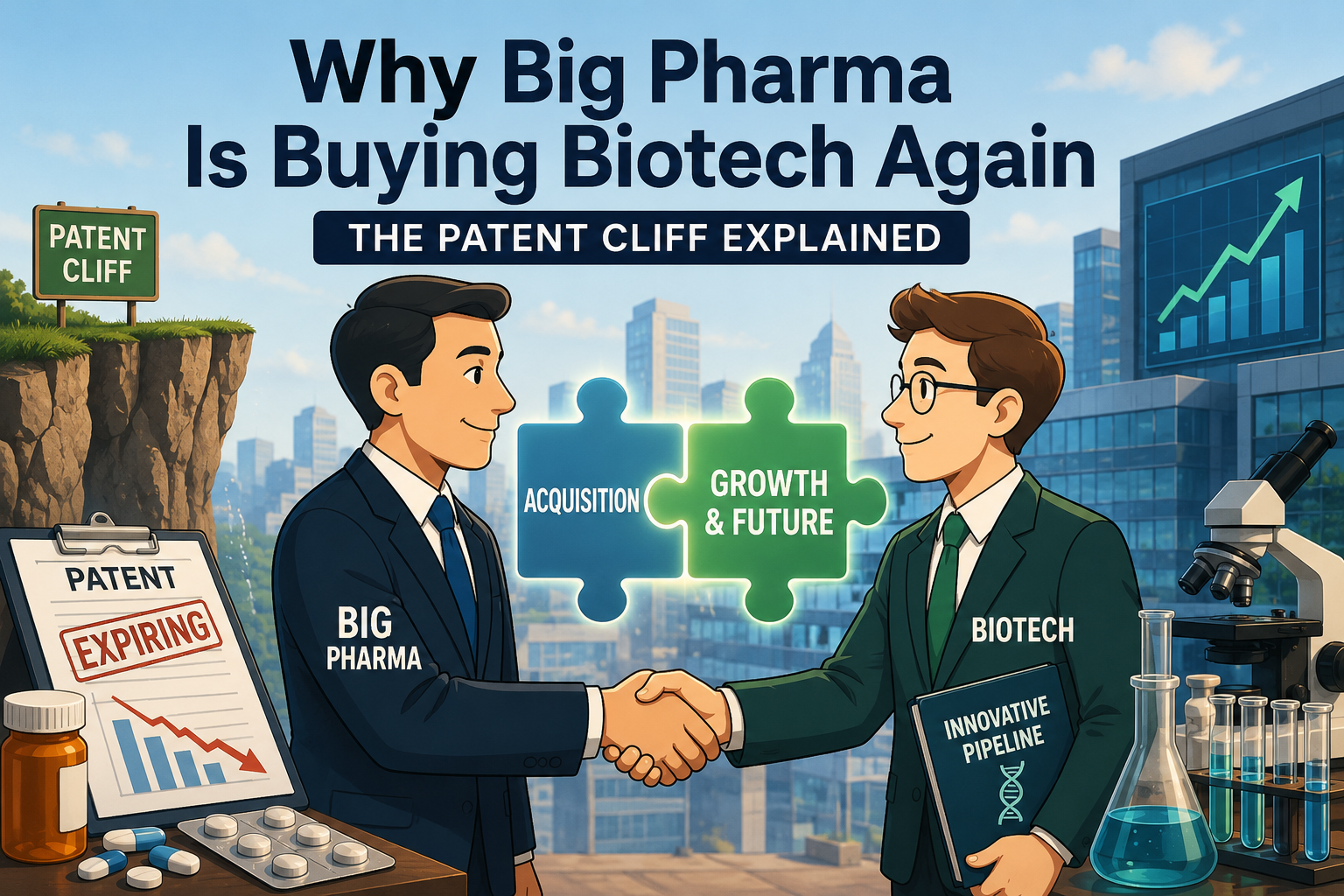
Patent expirations are pushing large drugmakers to buy promising biotech companies before future revenue begins to decline.
Key Takeaways
- Patent losses are creating urgency across the pharmaceutical industry.
- Biotech acquisitions can provide new medicines faster than early internal research.
- The value of each deal will ultimately depend on clinical and commercial execution.
Data Snapshot
| Indicator | Current Picture |
|---|---|
| 2026 M&A outlook | Deal volume and value expected to rise |
| Expected increase | Approximately 15% |
| Main pressure | Patent expirations |
| Common targets | Clinical-stage or near-market medicines |
Pharmaceutical M&A is expected to increase in 2026 as patent expirations push companies to strengthen their pipelines through external deals. (Link)
What Happened
Big Pharma is buying biotech companies again, and the approaching patent cliff is a major reason. (Link)
A patent cliff occurs when a successful medicine loses market exclusivity and lower-cost generic or biosimilar competitors enter. Sales can then fall quickly, leaving the original manufacturer with a large revenue gap.
Many major pharmaceutical companies face important patent expirations over the next several years. Developing a new medicine internally can take more than a decade, so companies are increasingly using acquisitions to gain products that are already in clinical development or on the market. Developing a new medicine internally can take more than a decade, so companies are increasingly using acquisitions to gain products that are already in clinical development or on the market.
Recent transactions show this strategy in action. GSK completed its approximately $10.6 billion acquisition of Nuvalent to add precision-oncology medicines, including lung cancer programs (Link). Merck acquired Verona Pharma for approximately $10 billion, gaining the marketed COPD medicine Ohtuvayre and a stronger position in respiratory disease (Link).
Why It Matters
Acquiring a biotech company can shorten the distance between investment and future revenue. A medicine with human clinical data is easier to evaluate than an early laboratory project, although it can still fail in later trials or face regulatory delays.
Competition also raises the risk of overpaying. Strong assets may attract several potential buyers, pushing acquisition prices above what future sales can reasonably support.
The current M&A wave is therefore not only about buying more science. It is about buying time before important patents expire.
BP View
The patent cliff explains much of today’s deal urgency, but it is not the only driver. Pharmaceutical companies are also using acquisitions to enter attractive markets, strengthen weak portfolios and compete for technologies they do not have internally.
Three questions matter most:
- Are buyers selecting medicines with clear clinical advantages?
- Are they paying prices that future sales can justify?
- Can they complete development and launch the products successfully?
The companies announcing the largest deals will not automatically become the winners. Success will depend on turning acquired assets into approved medicines and sustainable revenue.

Sources
- Come Together: Pharma M&A set to accelerate in 2026
- March M&A surge triggers high expectations for 2026
- GSK — GSK completes acquisition of Nuvalent
- Merck — Merck completes acquisition of Verona Pharma
Related Post
Can GSK Deliver Its £40 Billion Growth Ambition?
Here’s a previous BP post on how GSK is building its long-term growth strategy through oncology and HIV.
About BP
Biopharma Perspective (BP) provides concise analysis of global pharmaceutical and biotechnology developments.

Leave a Reply