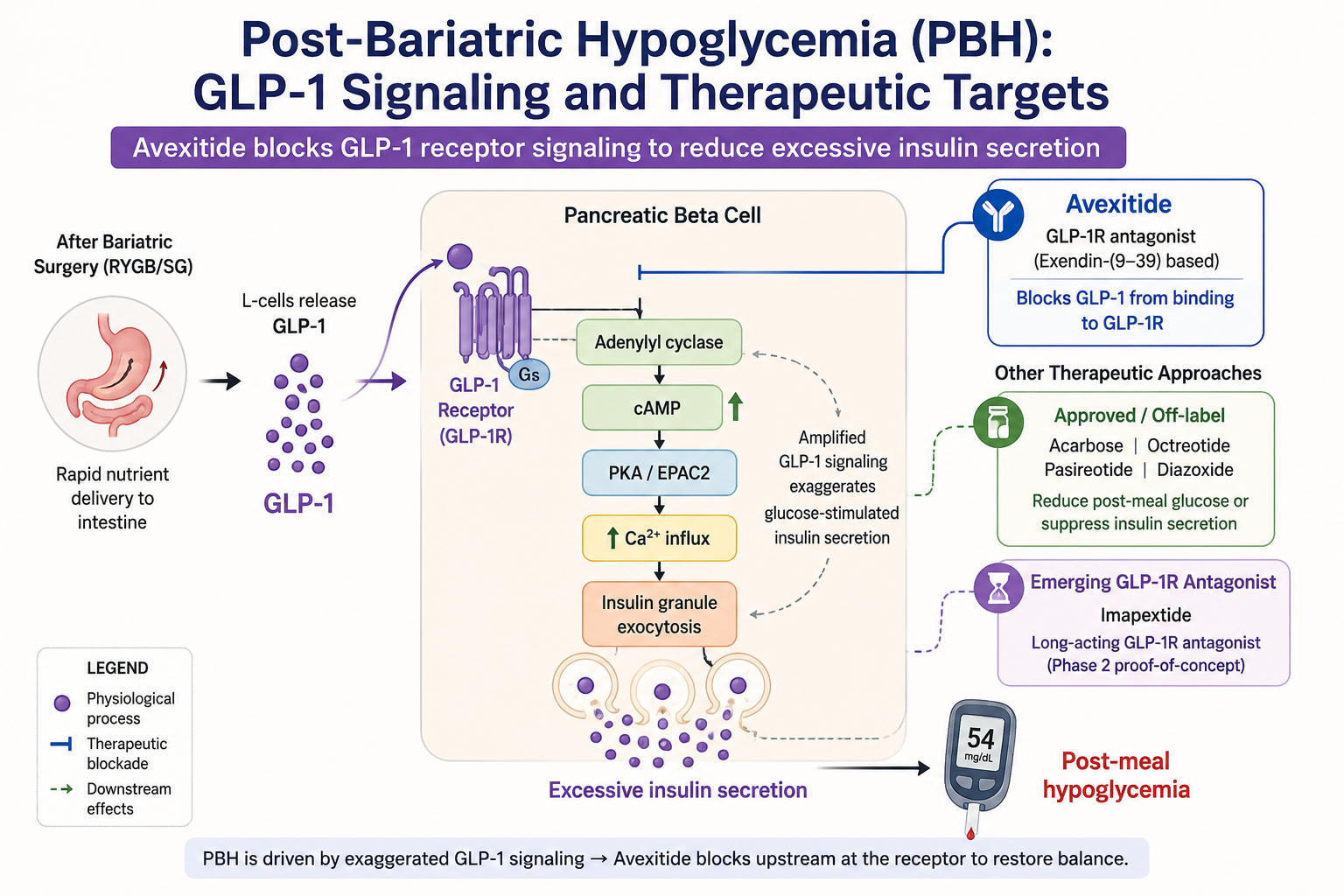
The science behind avexitide and the GLP-1 biology of post-bariatric hypoglycemia.
[Related Analysis]
For the clinical and strategic context, read our main BP analysis: [Amylyx Turns GLP-1 Biology in the Opposite Direction]
Science at a Glance
| Item | Details |
|---|---|
| Disease | Post-bariatric hypoglycemia (PBH) |
| Core biology | Excessive post-meal GLP-1 signaling and insulin secretion |
| Drug | Avexitide |
| Developer | Amylyx Pharmaceuticals |
| Modality | Peptide therapeutic |
| Target | GLP-1 receptor |
| Pharmacology | Competitive GLP-1 receptor antagonist |
| Therapeutic goal | Reduce inappropriate insulin secretion and stabilize glucose |
| Development stage | Phase 3 completed; U.S. filing planned |
Avexitide targets the same GLP-1 receptor widely activated in obesity and diabetes treatment, but uses it in the opposite pharmacological direction. Amylyx reported positive Phase 3 LUCIDITY results and is moving toward a U.S. marketing application.
1. Disease Biology — Why Does Hypoglycemia Occur After Bariatric Surgery?
Post-bariatric hypoglycemia (PBH) can occur after metabolic and bariatric procedures including Roux-en-Y gastric bypass (RYGB) and sleeve gastrectomy. The Phase 3 LUCIDITY trial specifically enrolled patients with PBH following RYGB.
After surgery, nutrients can reach the intestine rapidly. This can produce an exaggerated post-meal rise in glucagon-like peptide-1 (GLP-1), which amplifies insulin secretion from pancreatic beta cells.
In simplified form:
Rapid nutrient delivery → GLP-1 ↑ → insulin ↑↑ → post-meal hypoglycemia
Human studies using exendin-(9–39), the molecule on which avexitide is based, showed that GLP-1 receptor blockade reduced excessive insulin secretion and corrected post-bariatric hypoglycemia, supporting GLP-1 as a causal component of the disease biology.
2. Mechanism & Technology — How Does Avexitide Work?
[Insert molecular signaling pathway figure here]
Avexitide is a 31-amino-acid peptide GLP-1 receptor antagonist derived from exendin-(9–39). It competes with endogenous GLP-1 for binding to the GLP-1 receptor (GLP-1R) on pancreatic beta cells.
Normally, GLP-1R activation stimulates Gs protein → adenylyl cyclase → cAMP → PKA/EPAC2 signaling, which enhances calcium-dependent insulin granule release. In PBH, exaggerated GLP-1 signaling can excessively amplify this glucose-stimulated insulin response.
Avexitide interrupts this pathway upstream at the receptor:
GLP-1R blockade → reduced cAMP signaling → less amplification of Ca²⁺-dependent insulin secretion → reduced post-meal hypoglycemia
This differs fundamentally from GLP-1 receptor agonists used in obesity and diabetes, which deliberately activate the same receptor.

As a peptide therapeutic, avexitide is delivered by subcutaneous injection. The Phase 3 LUCIDITY study evaluated once-daily dosing in adults with RYGB-associated PBH.
3. Competitive Technology Landscape
There is currently no FDA-approved therapy specifically for PBH. Pharmacologic management therefore relies mainly on off-label therapies with different mechanisms.
| Approach | Example | Mechanism | PBH Status / Development Stage |
|---|---|---|---|
| Nutrient absorption control | Acarbose | α-glucosidase inhibition slows carbohydrate absorption | Off-label; established clinical use |
| Somatostatin receptor agonism | Octreotide | Suppresses gut hormone and insulin secretion | Off-label; established clinical use |
| Somatostatin receptor agonism | Pasireotide | Suppresses GLP-1 and insulin secretion | Off-label; studied clinically in PBH |
| KATP channel opening | Diazoxide | Hyperpolarizes beta cells and reduces insulin release | Off-label; limited clinical use |
| GLP-1 receptor blockade | Avexitide | Directly blocks excessive GLP-1-driven insulin secretion | Phase 3 completed; filing planned |
| Long-acting GLP-1 receptor blockade | Imapextide | Prolonged GLP-1 receptor antagonism | Phase 2a positive proof-of-concept |
Acarbose is generally used as a first pharmacologic option, followed by somatostatin analogues or diazoxide in selected patients. These treatments act indirectly on nutrient handling or insulin secretion rather than selectively blocking the GLP-1 receptor.
Avexitide is currently the most clinically advanced direct GLP-1 receptor antagonist in PBH. MBX Biosciences’ imapextide represents a competing strategy using longer-acting GLP-1 receptor blockade and has reported positive Phase 2a proof-of-concept data.
Science View
Avexitide shows how the same molecular target can support completely different therapeutic strategies depending on disease biology.
In obesity and diabetes, GLP-1 receptor activation is beneficial. In PBH, excessive GLP-1-mediated amplification of insulin secretion becomes part of the disease mechanism, creating a rationale for GLP-1 receptor blockade instead.
There is currently no FDA-approved therapy specifically for PBH. If avexitide is approved, it could become the first therapy specifically indicated for the condition.
The key scientific distinction is therefore not the target itself, but which direction the biology needs to be pushed.
About BP Science
BP Science explains the biology, mechanisms, modalities and technology landscapes behind emerging biopharma therapies.

Leave a Reply