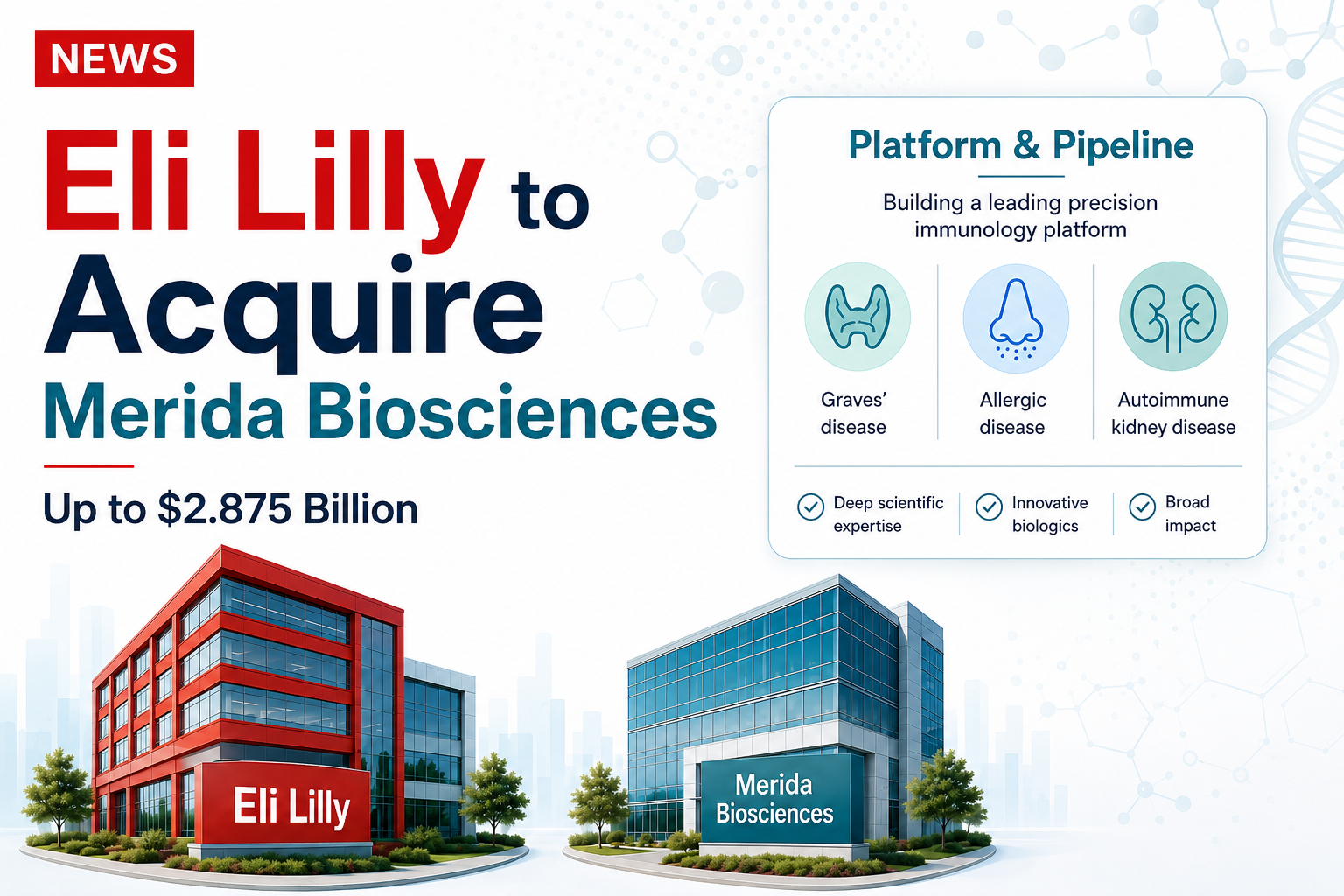
The acquisition gives Eli Lilly a precision autoantibody-degradation platform and a pipeline spanning Graves’ disease, thyroid eye disease, allergic disease and autoimmune kidney disease.
Key Takeaways
- Eli Lilly agreed to acquire Merida Biosciences for up to $2.875 billion, including an upfront payment and potential milestone payments.
- Merida’s platform is designed to selectively eliminate pathogenic antibodies while preserving normal immunoglobulins and physiological signaling.
- Beyond lead asset MER511, Merida is developing MER769 for IgE-mediated allergic diseases and MER683 for primary membranous nephropathy, with both programs in IND-enabling development.
Data Snapshot
| Item | Details |
|---|---|
| Acquirer | Eli Lilly |
| Target | Merida Biosciences |
| Deal value | Up to $2.875 billion |
| Deal structure | Upfront payment + potential milestones |
| Core technology | Selective degradation of pathogenic antibodies |
| Lead program | MER511 |
| Lead indications | Graves’ disease / thyroid eye disease |
| MER511 stage | Phase 1 |
| Additional programs | MER769 / MER683 |
| MER769 | IgE-mediated allergic diseases, IND-enabling |
| MER683 | Primary membranous nephropathy, IND-enabling |
The total potential deal value is approximately $2.875 billion. (Lilly acquisition)
What Happened
Eli Lilly announced an agreement to acquire Merida Biosciences for up to $2.875 billion, adding a precision immunology platform designed to selectively eliminate disease-causing antibodies. The transaction includes an upfront payment and potential milestone payments, although the upfront amount was not disclosed. (Lilly acquisition)
Merida’s technology is designed to recognize specific pathogenic antibodies and promote their removal through endogenous degradation pathways. The goal is to reduce disease-driving antibodies while preserving unrelated protective immunoglobulins. (Merida platform)
Independent industry coverage highlighted the deal as another major immunology investment by Lilly, with Merida’s selective autoantibody-degradation strategy differentiating it from broader IgG-lowering approaches. (Fierce Biotech)
A Pipeline Beyond MER511
Merida’s lead program, MER511, is being evaluated in the Phase 1 NEXUS study in adults with Graves’ disease and is also being developed for thyroid eye disease. MER511 is designed to selectively eliminate pathogenic TSH receptor autoantibodies while preserving normal thyroid signaling. (MER511 program)
The strategic value of the acquisition extends beyond MER511.
MER769 is an IND-enabling program designed to target pathogenic IgE in allergic diseases, including food allergy, asthma and chronic spontaneous urticaria.
MER683 is also in IND-enabling development for primary membranous nephropathy, an autoimmune kidney disease associated with pathogenic antibodies such as those targeting PLA2R. (Merida pipeline)
Together, these programs show how Merida intends to apply the same core platform across multiple diseases driven by different pathogenic antibodies.
Why It Matters
Many current therapies for antibody-mediated autoimmune diseases intervene indirectly.
B-cell-directed therapies can suppress antibody production, while FcRn inhibitors broadly reduce circulating IgG. Merida is pursuing a narrower strategy: identify the disease-driving antibody and selectively eliminate it while preserving the rest of the antibody repertoire.
If clinically validated, that approach could offer a different balance between efficacy and immune preservation compared with broad immunosuppression or global IgG reduction.
For Lilly, the acquisition therefore adds more than a single Phase 1 asset. It provides access to a repeatable precision immunology platform that could potentially generate therapies across several autoimmune and allergic diseases.

Want to know how MER511 selectively removes disease-causing TSHR autoantibodies in Graves’ disease?
Read the BP Science explainer:
How MER511 Selectively Removes Pathogenic Autoantibodies in Graves’ Disease
BP View
The most important part of this deal is not simply MER511. Lilly is acquiring a precision autoantibody-removal platform with the potential to generate multiple programs across immunology.
MER511 already provides an early human pharmacodynamic signal in Graves’ disease, where Lilly and Merida have reported robust reductions in pathogenic thyroid-stimulating antibodies with a favorable initial safety profile. However, detailed clinical efficacy data remain limited at this early Phase 1 stage. (Lilly–Merida)
The broader competitive landscape is also evolving quickly. FcRn inhibitors, B-cell-targeted therapies and extracellular protein degraders are all attempting to reduce pathogenic antibodies, but they differ substantially in selectivity. Merida’s central hypothesis is that removing only the disease-causing antibodies could preserve normal immune function while still addressing the molecular driver of disease.
In my view, Lilly is effectively buying an opportunity to build a broader precision immunology franchise, rather than simply acquiring another thyroid asset. The next major test will be whether MER511 can translate selective autoantibody reduction into durable clinical benefit and whether that success can be reproduced across MER769, MER683 and future programs.

Related Post
For another recent example of a targeted immunology strategy reaching the market, read my previous analysis of Priovant’s FDA approval of Lisraya in dermatomyositis.
About BP
Biopharma Perspective (BP) explains global biopharma news through strategic, clinical and market perspectives.
Have a different view on this acquisition or another angle you’d like to discuss? Leave a comment — I’d be happy to hear your thoughts.

Leave a Reply