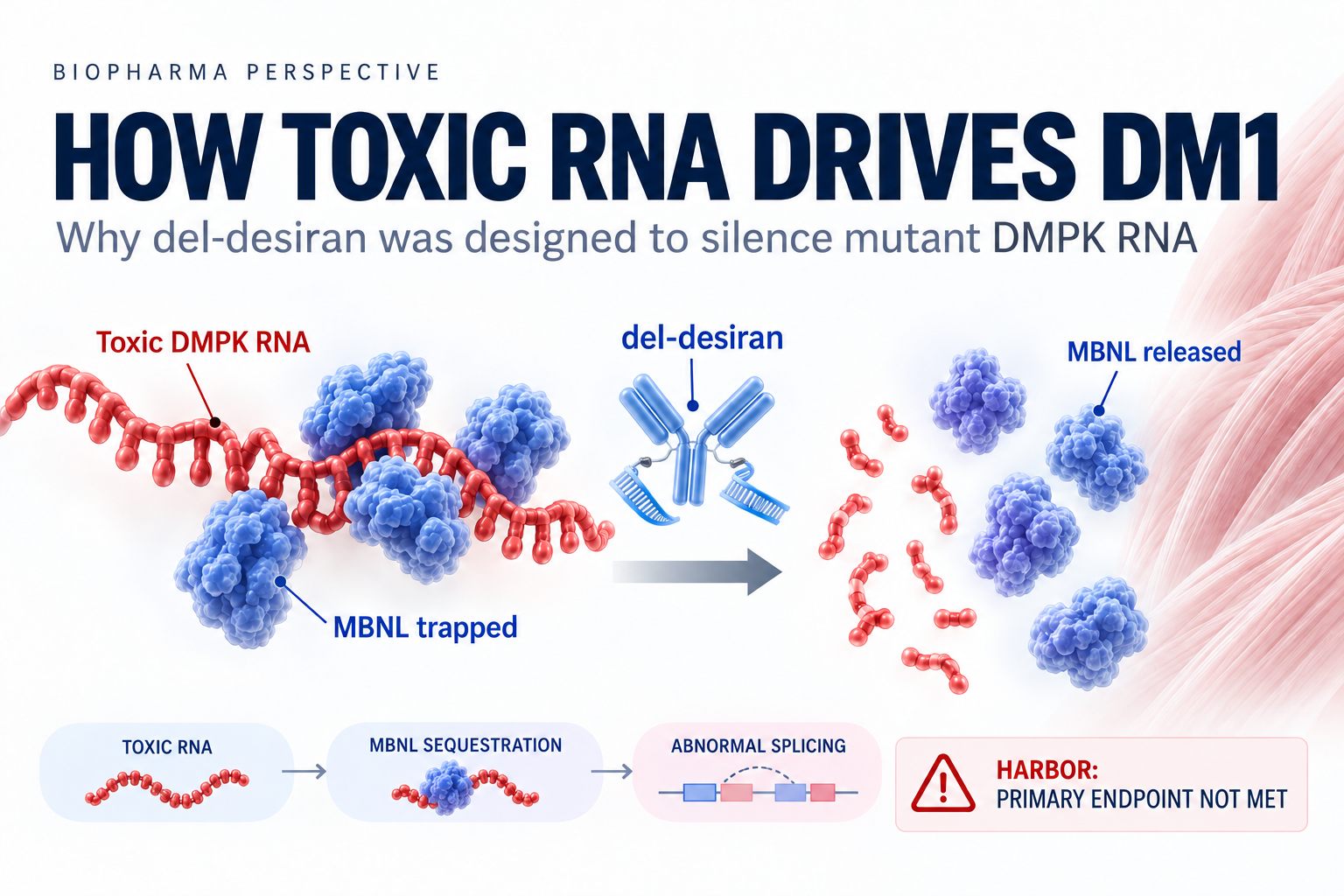
Del-desiran uses antibody-guided delivery of a DMPK-targeting siRNA to reduce toxic RNA in muscle, with the aim of releasing MBNL proteins and correcting abnormal RNA splicing.
Related Analysis
Want the news story behind this science? Read my analysis of Novartis’ Phase 3 HARBOR setback for del-desiran.
Science at a Glance
Delpacibart etedesiran (del-desiran) is an investigational antibody-oligonucleotide conjugate that uses a transferrin receptor 1 (TfR1)-targeting antibody to deliver a DMPK-directed small interfering RNA into muscle cells.
The siRNA is designed to reduce disease-causing DMPK mRNA, thereby lowering toxic CUG-repeat RNA that sequesters muscleblind-like (MBNL) proteins and disrupts alternative RNA splicing. (Del-desiran Phase 1/2 study)
| Item | Details |
|---|---|
| Candidate | Delpacibart etedesiran (del-desiran) |
| Company | Novartis / Avidity |
| Disease | Myotonic dystrophy type 1 (DM1) |
| Modality | Antibody-oligonucleotide conjugate |
| Delivery target | TfR1 |
| RNA target | DMPK mRNA |
| Payload | siRNA |
| Phase 3 trial | HARBOR |
| HARBOR design | ~150 patients, 54 weeks, Q8W |
| Primary endpoint | Video hand opening time (vHOT) |
| Outcome | Primary endpoint not met |
The therapeutic hypothesis is:
DMPK mRNA ↓ → toxic CUG-repeat RNA ↓ → MBNL sequestration ↓ → RNA splicing improves → muscle function improves
The first molecular steps had already been demonstrated. HARBOR tested whether those changes would translate into meaningful functional improvement.
What Goes Wrong in DM1?
DM1 is caused by an abnormal expansion of CTG repeats in the 3′ untranslated region of the DMPK gene.
When the mutant gene is transcribed, it produces DMPK RNA containing expanded CUG repeats. These transcripts accumulate in the nucleus and sequester MBNL proteins into RNA foci.
MBNL proteins are not produced from DMPK RNA. They are independent RNA-binding proteins that normally regulate alternative splicing across many transcripts, including genes involved in muscle function.
When toxic CUG-repeat RNA reduces the amount of functional MBNL available, normal RNA processing is disrupted.
The core disease mechanism can therefore be summarized as:
Expanded DMPK RNA → MBNL sequestration → widespread missplicing → DM1 dysfunction
This RNA gain-of-function mechanism is a central feature of DM1 pathology. (DM1 RNA toxicity and MBNL review)
How Del-desiran Was Designed to Intervene
RNA therapeutics face a practical challenge in DM1: getting enough oligonucleotide into skeletal muscle.
Del-desiran addresses that problem with an antibody-oligonucleotide conjugate.
Its antibody component binds TfR1 on muscle cells, promoting receptor-mediated uptake. The attached siRNA is then designed to engage the RNA interference machinery and reduce DMPK mRNA inside the cell.
The intended downstream sequence is:
DMPK mRNA reduction
→ less toxic CUG-repeat RNA
→ less MBNL sequestration
→ more functional MBNL available
→ improved regulation of alternative splicing

Del-desiran does not directly activate MBNL; it is designed to reduce the toxic DMPK RNA that traps MBNL proteins in the nucleus.
The Molecular Biology Appeared to Work
Earlier clinical studies supported this mechanism.
In the Phase 1/2 MARINA study, del-desiran reduced DMPK mRNA in muscle and improved disease-associated missplicing. The published analysis also reported increased estimated functional MBNL activity and dose-dependent correction of molecular pathology. (MARINA molecular analysis)
The Phase 1/2 study reported DMPK mRNA reductions of approximately 46%, 44% and 37% across the 1, 2 and 4 mg/kg dose groups, compared with 0.9% with placebo. Improvements in a composite missplicing score were also observed, particularly in the 2 and 4 mg/kg groups.
So the biological signal was real.
What remained uncertain was whether those molecular changes were large, durable and broadly distributed enough to improve patient function.
Where HARBOR Fell Short
The global Phase 3 HARBOR study evaluated del-desiran over 54 weeks in approximately 150 people with DM1, with dosing every eight weeks.
The primary endpoint was video hand opening time (vHOT), a quantitative measure of hand myotonia.
Del-desiran did not demonstrate a statistically significant improvement versus placebo on the primary endpoint. Novartis also reported evidence of clinical activity across secondary endpoints and exploratory analyses, while continuing to review the complete dataset. (Fierce Biotech HARBOR coverage)
BioPharma Dive similarly noted that the result raises questions about how well molecular correction with the AOC platform translates into clinical function in DM1. (BioPharma Dive HARBOR analysis)
The Phase 3 result therefore does not show that the RNA-targeting mechanism was inactive.
It shows that:
DMPK RNA reduction → molecular correction
did not translate convincingly enough into:
a statistically significant improvement in the HARBOR primary functional endpoint.
BP Science View
Del-desiran highlights a central challenge in RNA therapeutics: correcting molecular pathology is not automatically the same as correcting disease function.
The biological rationale remains strong. DM1 is driven in large part by toxic CUG-repeat RNA that sequesters MBNL, and earlier del-desiran studies showed that reducing DMPK RNA could improve molecular markers linked to that pathology.
HARBOR shifts the question further downstream. The key issue is now whether the degree and distribution of RNA correction were sufficient across the muscles and biological systems that determine meaningful patient function—or whether vHOT captured only part of the therapeutic effect.
The broader lesson is clear: RNA knockdown and splicing correction can validate a mechanism, but a disease-modifying therapy ultimately has to show that those molecular changes improve how patients function.
About BP Science
BP Science explains the biology and mechanisms behind emerging biopharmaceutical technologies, connecting molecular science with clinical and competitive development.
Have a question about my interpretation or another angle you’d like to discuss? Leave a comment — I’d be happy to hear your thoughts.

Leave a Reply