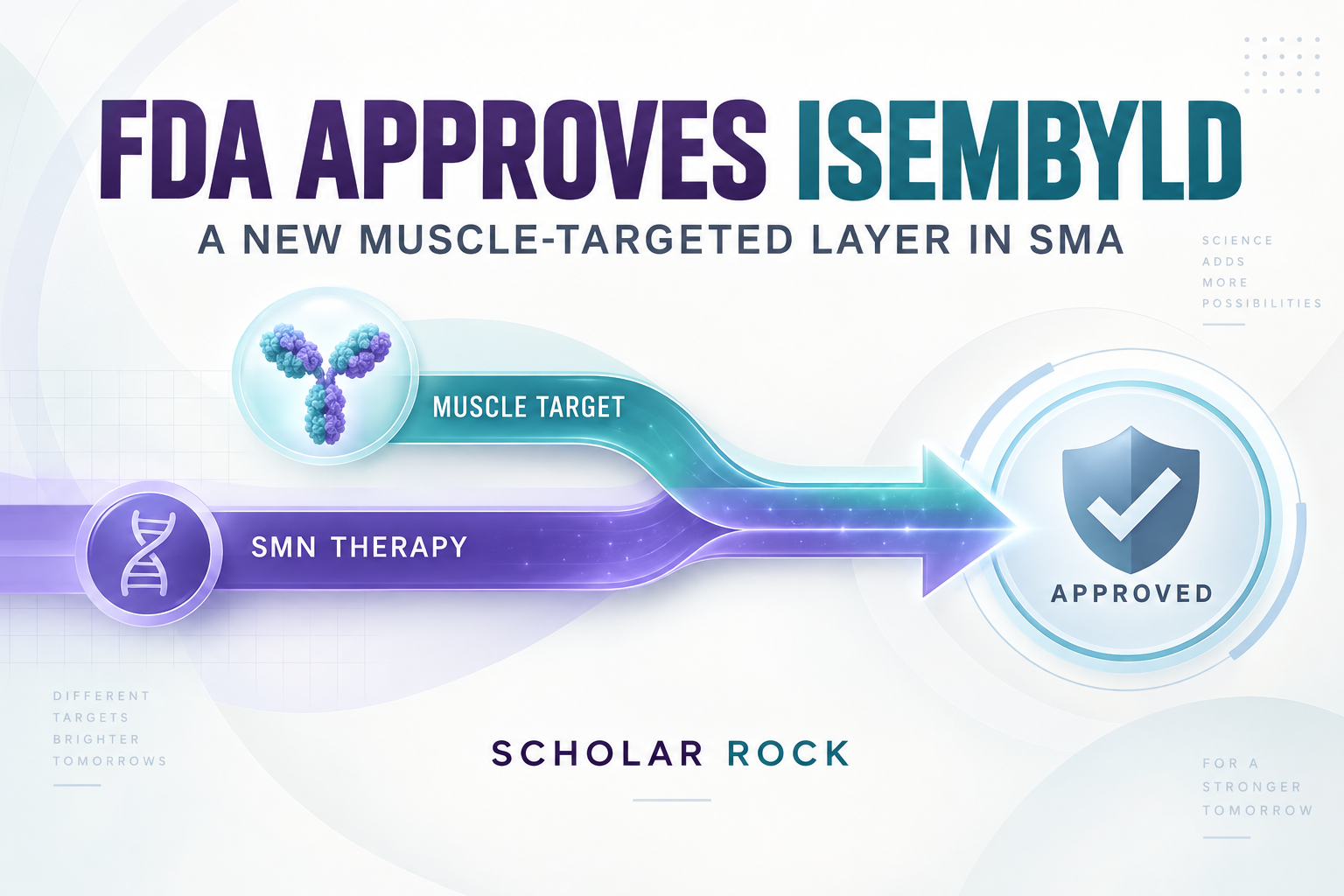
The first muscle-targeted SMA therapy adds a new treatment layer for patients already receiving SMN2-directed drugs.
Key Takeaways
- The FDA approved Isembyld for patients aged two years and older receiving chronic SMN2-targeted therapy.
- The approved 10 mg/kg dose improved HFMSE scores by 2.2 points versus placebo at Week 52.
- Isembyld targets skeletal muscle, distinguishing it from treatments that increase or replace SMN protein.
Data Snapshot
| Item | Details |
|---|---|
| Product | Isembyld (apitegromab-mstn) |
| Company | Scholar Rock |
| Approval date | September 11, 2026 |
| Indication | Spinal muscular atrophy |
| Eligible patients | Adults and children aged ≥2 years |
| Treatment requirement | Chronic SMN2-targeted therapy |
| Dose | 10 mg/kg IV every four weeks |
| Supporting trial | Phase 3 SAPPHIRE |
| Total enrollment | 188 patients |
| Approved-dose efficacy analysis | 103 patients aged 2–12 years |
| HFMSE difference | 2.2 points versus placebo |
| ≥3-point HFMSE improvement | 34.2% versus 13.5% |
Isembyld is an add-on treatment that targets muscle weakness remaining after the upstream SMN pathway has been addressed.
What Happened
The US Food and Drug Administration approved Scholar Rock’s Isembyld for spinal muscular atrophy (SMA) in patients aged two years and older who are receiving a survival motor neuron 2 (SMN2)-targeted therapy.
The approval makes Isembyld the first SMA treatment designed to act directly on skeletal muscle. It will be used alongside Biogen’s Spinraza (nusinersen) or Roche’s Evrysdi (risdiplam), rather than replacing them. The recommended regimen is 10 mg/kg by intravenous infusion every four weeks. (Scholar Rock Isembyld approval)
The decision also gives Scholar Rock its first commercial product.
What SAPPHIRE Showed
The randomized Phase 3 SAPPHIRE trial enrolled 188 nonambulatory patients aged 2–21 years with type 2 or type 3 SMA. All participants were receiving stable nusinersen or risdiplam.
In the 103-patient analysis of the approved 10 mg/kg dose, Isembyld produced a 2.2-point placebo-adjusted improvement on the Hammersmith Functional Motor Scale–Expanded at Week 52. At least a three-point improvement occurred in 34.2% of treated patients and 13.5% of placebo recipients.
The published primary analysis, which pooled the 10 mg/kg and 20 mg/kg groups in 156 children, reported a 1.8-point difference. The two figures reflect different prespecified analyses rather than conflicting results. (SAPPHIRE Phase 3 publication)
Why It Matters
Spinraza and Evrysdi increase functional SMN protein, while Novartis’ Zolgensma delivers a functional copy of the SMN1 gene. These therapies address the upstream cause of SMA but may not fully restore muscle capacity after prolonged denervation and atrophy.
Isembyld targets that downstream component. It prevents activation of myostatin, a protein that normally restricts skeletal-muscle growth.
SMN-directed therapies preserve motor neurons; Isembyld attempts to improve the response of the muscles they control.
The Science Behind Isembyld

The figure above shows how Isembyld is designed to complement—not replace—SMN-directed therapy in spinal muscular atrophy. Existing SMN2 therapies partially restore SMN protein and support motor-neuron function, but residual muscle weakness can remain. Isembyld targets this downstream muscle deficit by preventing myostatin activation, reducing ActRIIB–SMAD2/3 signaling and releasing part of the physiologic brake on muscle growth.
Its role is therefore complementary: SMN therapy addresses the upstream disease biology, while Isembyld acts directly on skeletal muscle to improve residual weakness.
The Commercial Question
Isembyld currently has no approved muscle-targeted rival in SMA. Its commercial challenge will be convincing physicians and payers that the additional motor-function benefit justifies another chronic therapy and an intravenous infusion every four weeks.
Safety will also matter. Fractures occurred in 9% of patients receiving Isembyld 10 mg/kg and 2% of placebo recipients in SAPPHIRE. (Scholar Rock approval announcement)
Analysts cited by Reuters estimate peak global sales of $2.1 billion by 2035—approximately ₩2.9 trillion, assuming ₩1,380 per US dollar. (Reuters Isembyld coverage)
BP View
Isembyld adds muscle-directed treatment to an SMA market built around SMN restoration. This complementary position gives Scholar Rock limited direct mechanistic competition without requiring the drug to replace Spinraza or Evrysdi.
The launch will ultimately test whether a 2.2-point motor-function benefit outweighs the burden, safety risk and cost of adding long-term intravenous treatment.
Isembyld’s approval marks a shift from treating the genetic pathway alone to treating both motor neurons and muscle.

Related Post
Read my previous news analysis of Novartis’ Phase 3 setback in myotonic dystrophy type 1.
Novartis’ Del-desiran Misses the Primary Endpoint in Phase 3 DM1 Trial
About BP
Biopharma Perspective provides independent analysis of pharmaceutical and biotechnology news, connecting clinical data, regulatory decisions and competitive strategy.

Leave a Reply