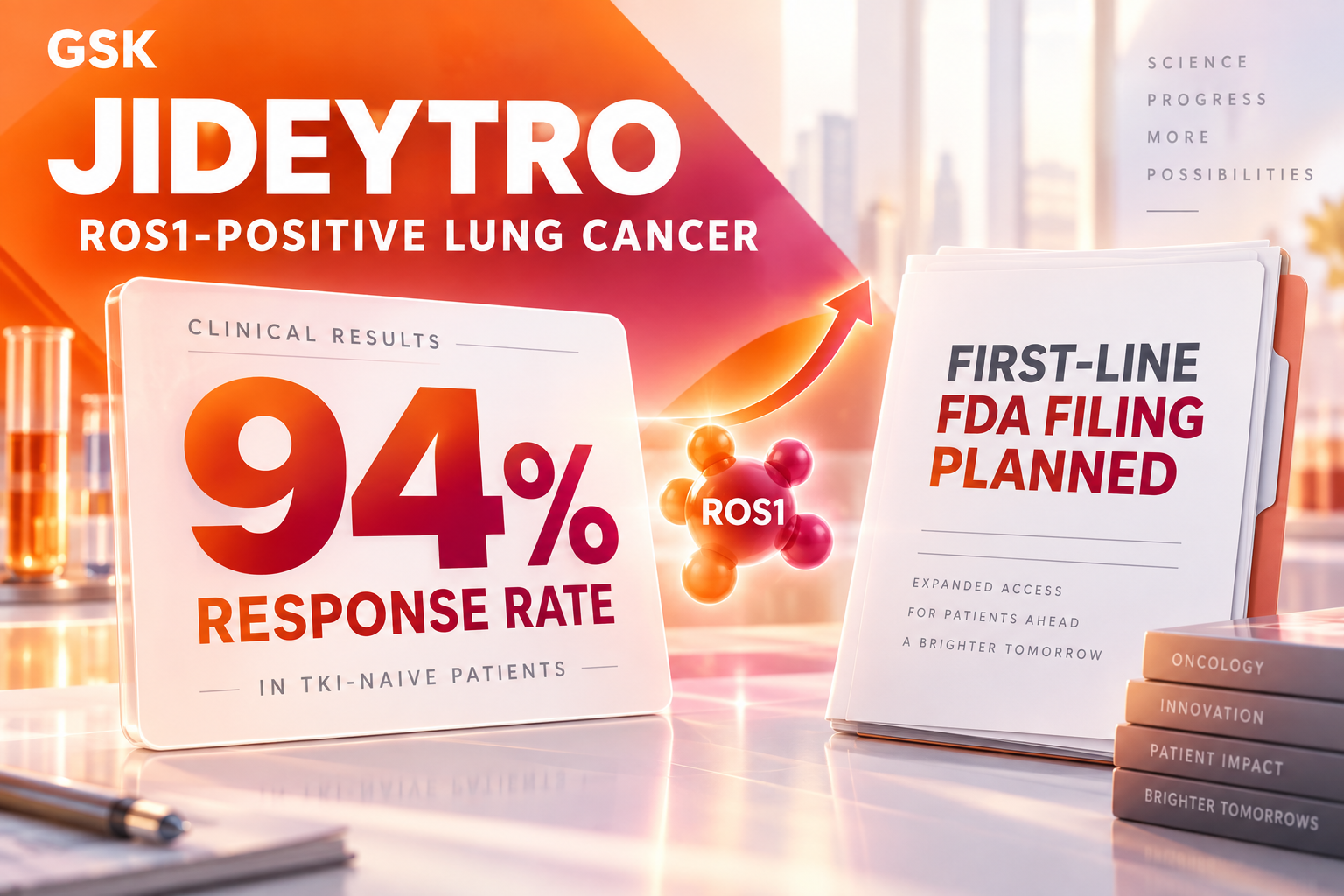
New ARROS-1 data support a planned 2026 FDA submission in TKI-naïve ROS1-positive lung cancer.
Key Takeaways
- Jideytro achieved a 94% objective response rate in 94 evaluable patients who had not previously received a ROS1 TKI.
- At 12 months, 86% of responders remained in response and 90% of patients were progression-free.
- Jideytro is not yet approved for first-line use; GSK plans to seek an FDA label expansion in 2026.
Data Snapshot
| Item | Details |
|---|---|
| Product | Jideytro |
| Generic name | Zidesamtinib |
| Company | GSK |
| Study | Phase 1/2 ARROS-1 |
| Population | Advanced or metastatic ROS1-positive NSCLC |
| Treatment setting | ROS1 TKI-naïve |
| Efficacy-evaluable patients | 94 |
| Objective response rate | 94% (88/94; 95% CI: 87–98) |
| Complete response rate | 15% (14/94) |
| Responders still in response at 12 months | 86% |
| Progression-free at 12 months | 90% |
| Intracranial response rate | 100% (10/10) |
| Intracranial complete response rate | 70% (7/10) |
| Median follow-up | 15.2 months |
| Dose | 100 mg orally once daily |
| Next step | Supplemental FDA filing planned in 2026 |
Median duration of response and median progression-free survival had not been reached at the April 16, 2026 data cutoff.
What Happened
GSK reported registrational results for Jideytro (zidesamtinib) in patients with advanced or metastatic ROS1-positive non-small cell lung cancer (NSCLC) who had not previously received a ROS1 tyrosine kinase inhibitor (TKI).
In the Phase 1/2 ARROS-1 study, 88 of 94 efficacy-evaluable patients responded and 14 achieved a complete response. Responses remained durable at the reported follow-up, while the median duration of response and median progression-free survival had not yet been reached.
The cohort was ROS1 TKI-naïve but not entirely treatment-naïve. ARROS-1 permitted one previous line of chemotherapy and/or immunotherapy, and 27% of the efficacy population had received chemotherapy.
Jideytro also produced responses in all 10 patients with measurable brain metastases, including seven intracranial complete responses. This CNS analysis is encouraging but remains too small to support firm comparisons with competing drugs.
Across 532 patients treated in any line, treatment-related adverse events led to dose reductions in 11% and discontinuation in 1%. The common events included peripheral edema, weight gain, increased creatine phosphokinase, dysgeusia and elevated aspartate aminotransferase; most were low grade. (GSK ARROS-1 results)
Why It Matters
Jideytro is already FDA-approved for adults with locally advanced or metastatic ROS1-positive NSCLC following at least one prior ROS1 TKI. Its recommended regimen is 100 mg orally once daily. (FDA Jideytro approval)
The new data could move the drug from a post-TKI option to an initial ROS1-targeted treatment. That would substantially expand its eligible population and give GSK access to patients before resistance to another ROS1 inhibitor develops.
First-line competition, however, is no longer determined by tumor shrinkage alone. ROS1-positive NSCLC often requires prolonged therapy and has a meaningful risk of brain progression. Durability, CNS control and tolerability are therefore central to treatment selection.
The Science Behind Jideytro

Jideytro is a macrocyclic, ROS1-selective inhibitor designed to retain activity against resistance mutations such as G2032R, enter the central nervous system and limit off-target TRK inhibition.
Read my BP Science analysis of how Jideytro blocks ROS1 fusion signaling.
How Jideytro Blocks ROS1 Fusion Signaling in Lung Cancer
A Strong Result in a Crowded ROS1 Market
Jideytro would enter a first-line market that already includes Pfizer’s Xalkori, Roche’s Rozlytrek, Bristol Myers Squibb’s Augtyro and Nuvation Bio’s Ibtrozi.
| Competitive factor | Question for Jideytro |
|---|---|
| Response durability | Will the median response remain strong with longer follow-up? |
| CNS control | Will the 10-patient intracranial result hold in a larger population? |
| Tolerability | Can low dose-reduction and discontinuation rates be maintained? |
| Resistance | Which mutations will emerge after first-line treatment? |
| Evidence | Will single-arm data be sufficient for FDA expansion? |
Fierce Pharma highlighted Jideytro’s complete response rate and 12-month durability as potentially differentiating features against Ibtrozi. The comparison remains cross-trial and does not establish clinical superiority. (Fierce Pharma Jideytro coverage)
BP View
The ARROS-1 results give GSK a credible basis for a first-line FDA filing. The clinically important signal is not only the response rate but the combination of durability, CNS activity and low treatment-discontinuation rates.
The main limitation is evidence maturity. ARROS-1 is a single-arm study, the intracranial population included only 10 evaluable patients and median survival measures have not yet been reached.
Jideytro therefore has a compelling profile, but not yet proof of superiority over established ROS1 inhibitors. Longer follow-up will show whether its molecular design produces more durable control in routine first-line use.
Jideytro has cleared the response-rate hurdle. Its competitive position will depend on how long that control lasts and how consistently it extends to the brain.

Related Post
HER2-mutant NSCLC is undergoing a similar shift toward earlier use of mutation-directed oral therapies.
Read my previous news analysis of Bayer’s first-line Hyrnuo approval.
Bayer’s Hyrnuo Wins First-Line FDA Approval in HER2-Mutant Lung Cancer
About BP
Biopharma Perspective provides independent analysis of pharmaceutical and biotechnology news, connecting clinical data, regulatory decisions and competitive strategy.
Have a question about my analysis or another angle you would like to discuss? Leave a comment—I’d be happy to hear your thoughts.

Leave a Reply