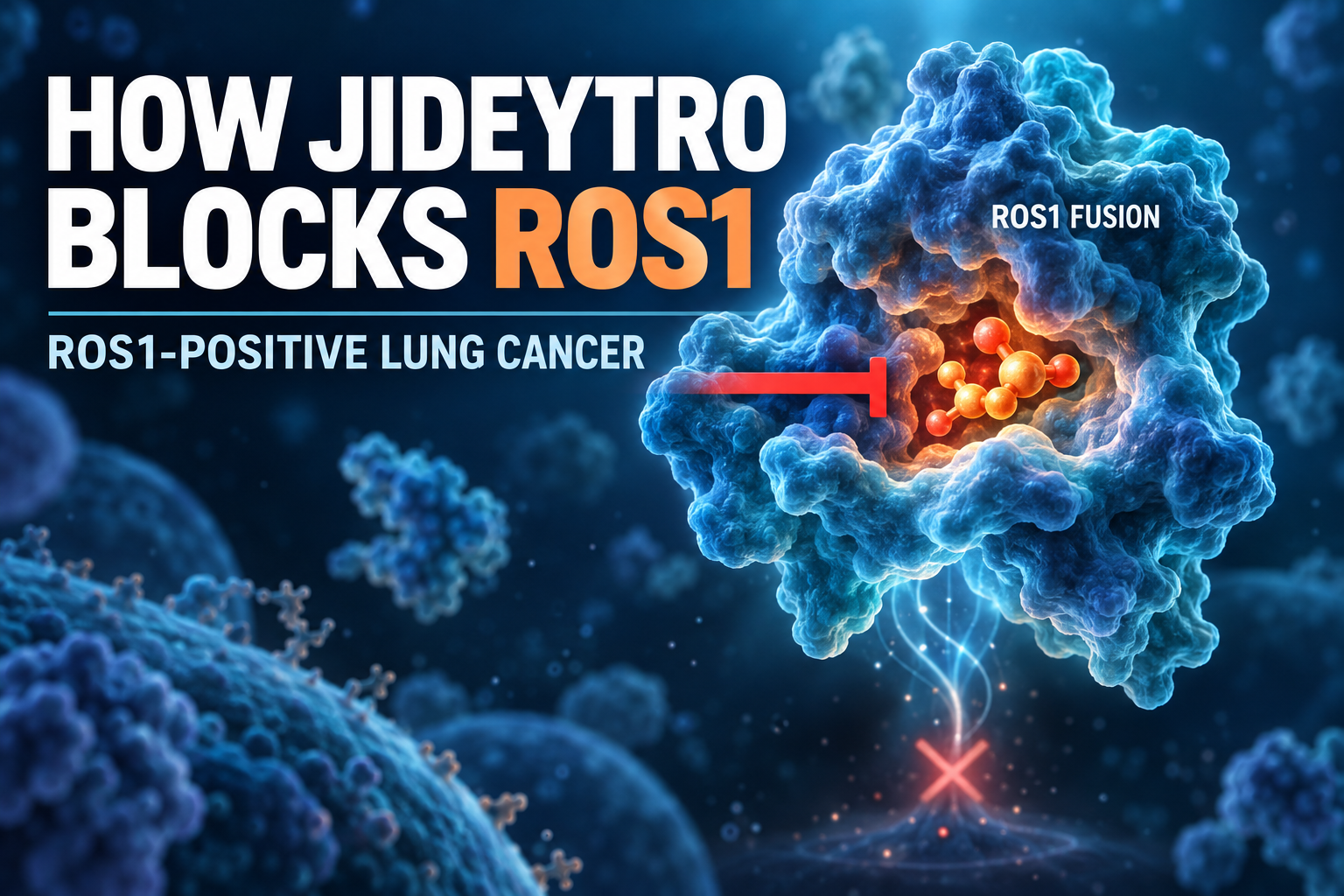
GSK’s macrocyclic inhibitor was designed to combine resistant-ROS1 coverage, brain penetration and reduced off-target TRK inhibition.
Related Analysis
Want the news story behind this science? Read my analysis of GSK’s plan to move Jideytro into TKI-naïve ROS1-positive lung cancer.
GSK Plans First-Line Jideytro Filing After 94% Response Rate
Science at a Glance
| Item | Details |
|---|---|
| Product | Jideytro |
| Generic name | Zidesamtinib |
| Former code | NVL-520 |
| Company | GSK |
| Modality | Oral macrocyclic small-molecule TKI |
| Primary target | ROS1 fusion kinase |
| Binding mechanism | ATP-competitive inhibition |
| Key design features | G2032R coverage, brain penetration and TRK sparing |
| US indication | Advanced ROS1-positive NSCLC after at least one ROS1 TKI |
Jideytro received FDA approval in July 2026 for adults with locally advanced or metastatic ROS1-positive non-small cell lung cancer (NSCLC) previously treated with a ROS1 tyrosine kinase inhibitor (TKI). (FDA Jideytro approval)
Mechanistically Relevant ROS1 Inhibitors
| Product | Target profile | Mechanistic distinction |
|---|---|---|
| Jideytro | ROS1-selective | G2032R coverage, CNS penetration and TRK-sparing design |
| Ibtrozi | ROS1-selective | CNS activity and resistance-mutation coverage |
| Augtyro | ROS1, TRK and ALK | Macrocyclic inhibitor with CNS and solvent-front activity |
| Rozlytrek | ROS1, TRK and ALK | CNS penetration but limited G2032R activity |
| Xalkori | ROS1, ALK and MET | Earlier inhibitor with weaker CNS and resistance coverage |
These products are all oral small-molecule TKIs. Jideytro is differentiated by its combined selectivity, CNS exposure and resistance coverage—not by a different therapeutic modality. (ROS1 treatment landscape review)
How Does a ROS1 Fusion Drive Cancer?
A ROS1 fusion forms when the kinase-containing portion of the ROS1 gene becomes joined to another gene through a chromosomal rearrangement.
The fusion partner promotes abnormal clustering of the resulting protein, keeping the ROS1 kinase active without an external ligand. This constitutive activity drives the RAS–RAF–MEK–ERK pathway, which supports proliferation, and the PI3K–AKT–mTOR pathway, which promotes cell survival and growth. JAK–STAT signaling may also contribute.
ROS1-positive tumors can therefore become dependent on a continuously active kinase signal.
Jideytro occupies the ATP-binding pocket of ROS1. By competing with adenosine triphosphate (ATP), it prevents kinase phosphorylation and weakens the downstream signals that sustain tumor-cell growth.
The drug does not remove the ROS1 fusion. It blocks the enzymatic activity produced by that fusion.

Why Was Jideytro Designed Differently?
Earlier ROS1 inhibitors face three recurring problems: acquired kinase mutations, brain metastases and off-target inhibition.
The ROS1 G2032R mutation replaces glycine with the larger amino acid arginine at the solvent front of the kinase. This substitution creates steric interference that can prevent several earlier inhibitors from binding effectively.
Jideytro uses a compact macrocyclic structure designed to retain access to the ATP pocket despite G2032R. Preclinical studies showed activity against multiple ROS1 fusions and secondary resistance mutations.
The same study found that NVL-520 was more than 50-fold selective for ROS1 over 98% of the tested kinome. In biochemical assays, it was 185-fold more selective for wild-type ROS1 than for tropomyosin receptor kinase A (TRKA). These values describe preclinical target selectivity, not clinical efficacy. (Cancer Discovery study)
Brain penetration addresses a separate limitation. ROS1-positive NSCLC frequently involves the central nervous system (CNS), where inadequate drug exposure can allow tumors to escape systemic control.
TRK sparing is intended to improve precision. ROS1 and TRK have structurally similar kinase domains, and some ROS1 inhibitors block both families. Because TRK proteins have normal neurological functions, unnecessary TRK inhibition can contribute to neurological adverse effects.
“TRK-sparing” describes a substantial selectivity margin; it does not mean that Jideytro has absolutely no interaction with TRK.
What Can Jideytro Not Solve?
Jideytro is not resistance-proof.
A tumor may acquire another ROS1 mutation or activate a bypass driver such as EGFR, MET or KRAS. Either route can restore downstream growth signaling despite continued ROS1 inhibition.
Molecular profiling after progression will therefore remain necessary to identify how each tumor escapes treatment.
BP Science View
Jideytro reflects a shift from broad multikinase inhibition toward structure-guided precision.
Its design addresses three weaknesses of earlier ROS1 therapies at once: resistance at the kinase pocket, limited exposure in the brain and unwanted TRK inhibition. The competitive question is whether this molecular balance produces durable control without adding new escape routes.
Jideytro is designed not simply to inhibit ROS1 more strongly, but to deliver ROS1 inhibition across resistant variants and the brain while limiting activity against targets that do not need to be blocked.
About BP Science
BP Science explains the biology and mechanisms behind emerging biopharmaceutical technologies, connecting molecular science with clinical and competitive development.
Have a question about my interpretation or another scientific angle you would like to discuss? Leave a comment—I’d be happy to hear your thoughts.

Leave a Reply