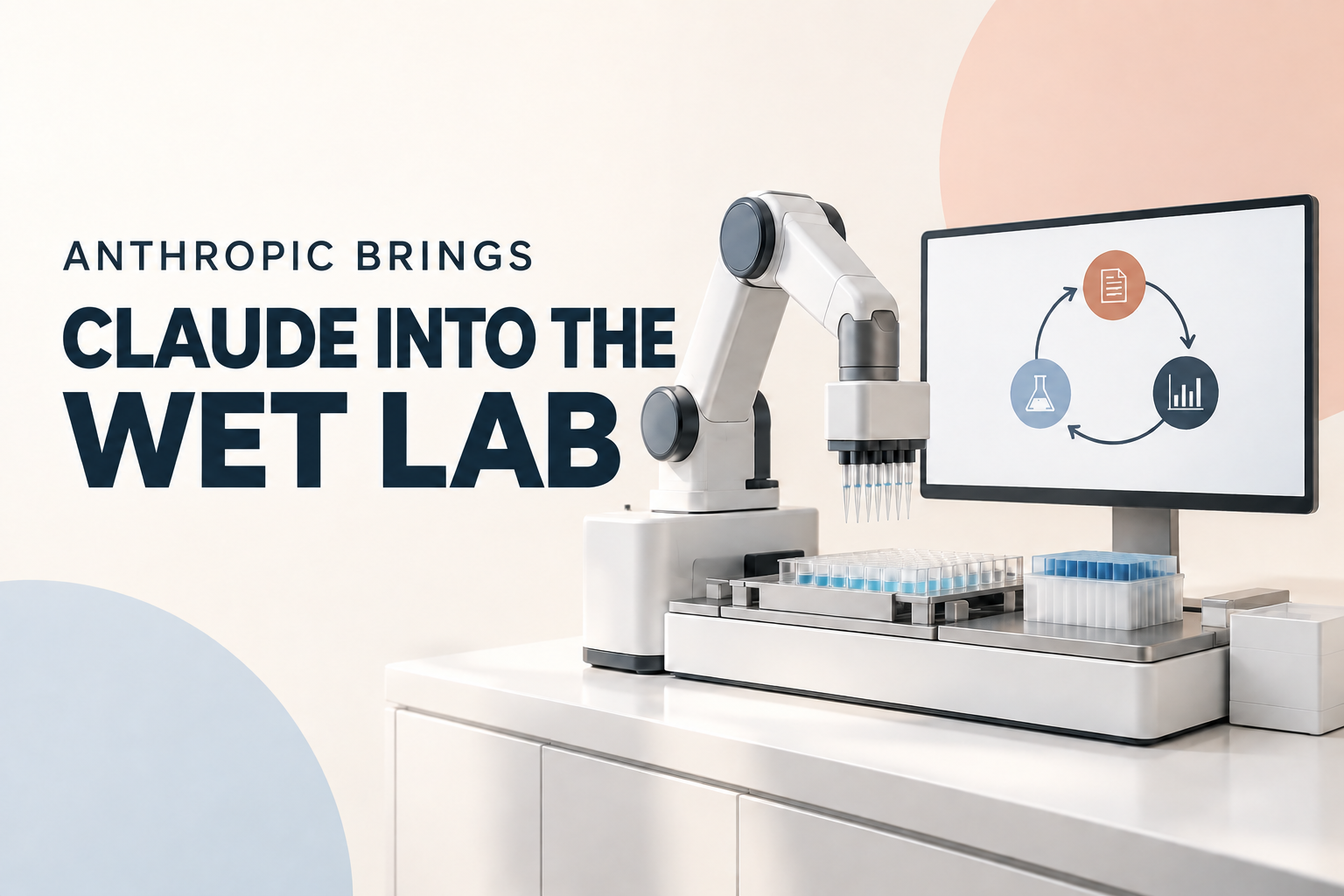
The AI company is connecting Claude with laboratory equipment, but autonomous drug discovery remains a long-term goal.
Key Takeaways
- Anthropic has established a wet lab in the San Francisco Bay Area to test Claude in physical biology experiments.
- Its Model Hardware Standard connects AI agents with instruments such as liquid handlers, microscopes, and robotic arms.
- The facility supports early-stage and preclinical research rather than clinical development or end-to-end drug discovery.
Data Snapshot
| Category | Detail |
|---|---|
| Company | Anthropic |
| AI system | Claude |
| Facility | Physical biology wet lab |
| Location | San Francisco Bay Area |
| Hardware interface | Model Hardware Standard |
| Research scope | Early-stage and preclinical biology |
| Human trials | No current plans |
What Happened
Anthropic has established a wet lab in the San Francisco Bay Area to test how Claude can support physical biology experiments. The facility moves the company beyond literature analysis and computer-based research by giving its AI models access to real experimental feedback.
Anthropic has clarified that the lab is not intended to operate as an end-to-end drug-discovery company. Its immediate purpose is to evaluate AI-assisted experimentation in early-stage and preclinical biology, with no current plans to conduct human clinical trials. (Techstrong AI wet-lab report)
Why It Matters
The main bottleneck in AI-driven biology is no longer limited to generating hypotheses. Predictions must still be tested through physical experiments, where liquid handling, instrument calibration, biological variability, and unexpected errors can affect the result.
Anthropic’s Model Hardware Standard (MHS) provides a common interface between AI agents and programmable equipment. In a Genentech proof of concept, Claude coordinated a liquid handler, robotic arm, and plate reader during a protein assay. It adjusted operating parameters using experimental data but still required human guidance when physical problems such as bubbles disrupted the workflow. (Anthropic Model Hardware Standard)
The intended workflow is therefore:
Researcher defines the biological goal → Claude plans the workflow → MHS coordinates laboratory equipment → experimental data return to Claude → Claude analyzes and adjusts → researcher reviews the result

How Pharmaceutical Companies Are Using Claude
| Company | Disclosed use |
|---|---|
| Genentech | Testing MHS and Claude for laboratory automation |
| Sanofi | Combining Claude with internal knowledge through its Concierge application |
| Novo Nordisk | Automating documents and content across pharmaceutical development |
| Genmab | Supporting clinical data workflows and GxP-compliant outputs |
These examples represent different levels of adoption. Genentech has disclosed direct laboratory automation, while Sanofi, Novo Nordisk, and Genmab are applying Claude across research, development, clinical, or enterprise workflows. (Anthropic Claude for Life Sciences)
BP View
Anthropic’s wet lab does not mean that Claude can independently discover and develop a drug. Its near-term value lies in connecting reasoning, laboratory equipment, and experimental data within a repeatable feedback loop.
The strategic asset may be the data generated when AI decisions encounter physical constraints. Each failed transfer, equipment error, or unexpected assay result can reveal where a model’s biological and physical reasoning remains incomplete.
For pharmaceutical companies, the opportunity is faster experimental iteration rather than the removal of scientists. Human judgment remains necessary for setting biological goals, interpreting uncertain results, and deciding which experiments should move forward.

Latest Analysis
For my latest biopharma coverage, read: Eli Lilly’s Inluriyo–Verzenio Combination Wins FDA Approval in ESR1-Mutated Breast Cancer.
About BP
Biopharma Perspective provides independent analysis of biotechnology, pharmaceuticals, clinical development, and the mechanisms shaping the next generation of medicines.

Leave a Reply