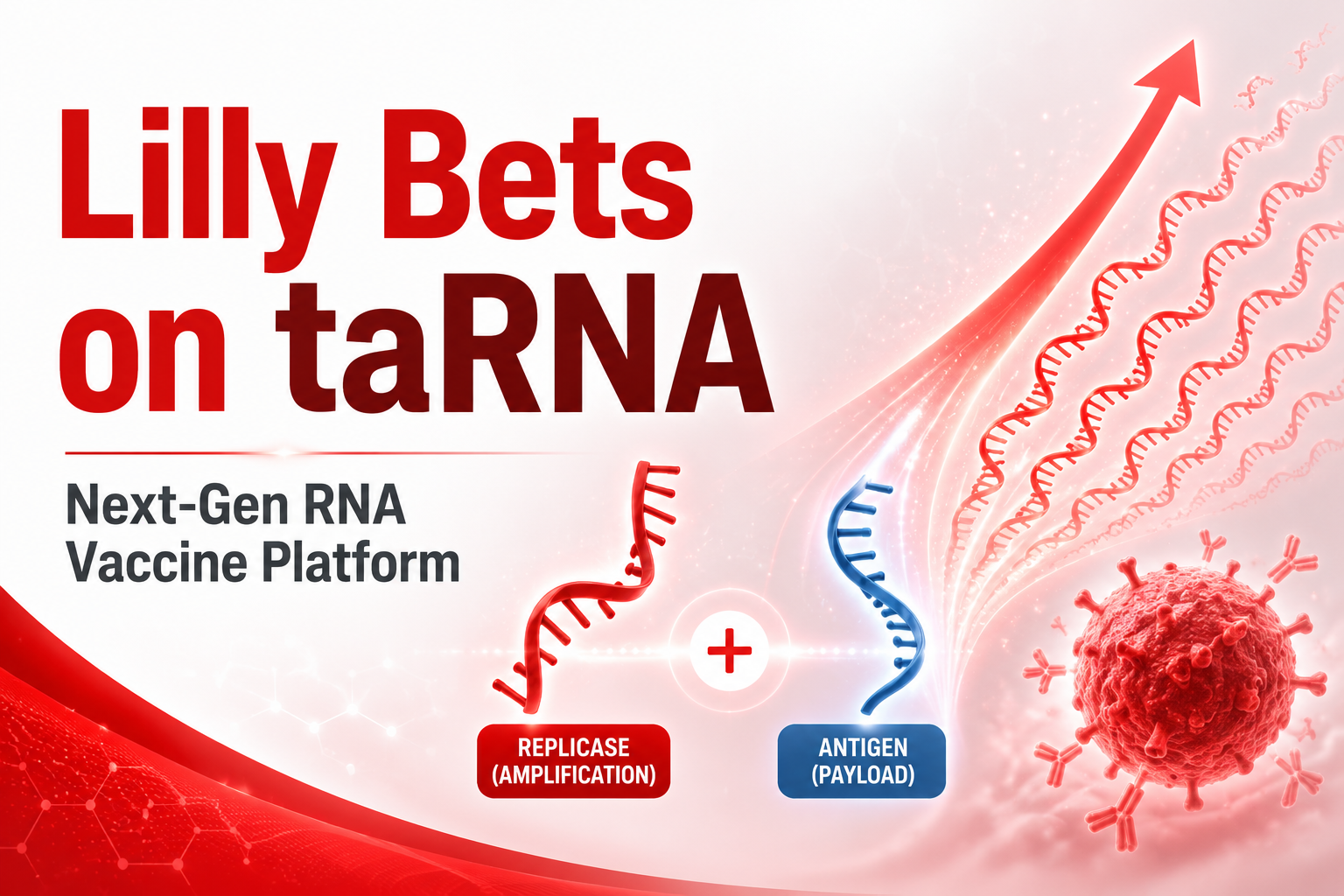
The collaboration gives Eli Lilly access to a modular RNA amplification platform designed for next-generation infectious-disease vaccines.
Key Takeaways
- Eli Lilly and Amplitude Therapeutics entered a strategic collaboration to develop trans-amplifying RNA (taRNA) vaccines for infectious diseases.
- The initial vaccine targets are undisclosed, while Lilly retains options to add up to two additional infectious-disease targets.
- Amplitude’s taRNA platform separates the RNA encoding the replicase from the RNA encoding the antigen, creating a more modular amplification system.
Data Snapshot
| Item | Details |
|---|---|
| Companies | Eli Lilly + Amplitude Therapeutics |
| Technology | Trans-amplifying RNA (taRNA) |
| Initial focus | Infectious-disease vaccines |
| Targets | Undisclosed |
| Additional options | Up to 2 targets |
| Development stage | Preclinical collaboration |
| Amplitude role | taRNA optimization + selected preclinical research |
| Lilly role | Later development, manufacturing, regulatory and commercialization |
| Financial terms | Not disclosed |
Lilly will receive exclusive, target-specific rights to develop and commercialize products generated under the collaboration. (Amplitude–Lilly collaboration)
What Happened
Amplitude Therapeutics announced a strategic research and licensing collaboration with Eli Lilly to develop taRNA vaccine candidates for infectious diseases with high unmet need. The companies did not disclose the initial disease targets or financial terms. (Amplitude–Lilly collaboration)
Amplitude will lead optimization of its taRNA platform and selected preclinical research. Lilly will take responsibility for subsequent preclinical development, clinical development, manufacturing, regulatory activities and commercialization, while retaining the option to add up to two more infectious-disease targets. (Fierce Biotech deal report)
Why It Matters
Amplitude’s taRNA technology separates the replicase-encoding RNA from the antigen-encoding RNA. Once the replicase is produced inside the cell, it can amplify the separate antigen RNA, potentially increasing antigen expression from a relatively small amount of antigen-encoding RNA. This split architecture distinguishes taRNA from conventional mRNA and self-amplifying RNA. (taRNA scientific review)
Amplitude says this modular design may enable greater potency, lower doses and improved manufacturability, while allowing the replicase and antigen components to be optimized separately. These remain potential platform advantages that will need to be demonstrated clinically. (Amplitude taRNA platform overview)

Curious about how taRNA differs from conventional mRNA and self-amplifying RNA?
Read our BP Science explainer: [How Trans-Amplifying RNA Could Extend the mRNA Platform]
For Lilly, the agreement provides access to a next-generation RNA platform without requiring the company to build the underlying technology entirely in-house. For Amplitude, the collaboration brings Lilly’s global development, manufacturing and commercialization capabilities to an early-stage platform.
BP View
This collaboration is more interesting as a platform investment than as a single vaccine deal.
The central promise of taRNA is modularity: separating the replicase and antigen components could allow new antigens to be exchanged while retaining the same amplification machinery.
However, the technology remains preclinical. Its potential advantages in dose, potency and manufacturing still need to translate into meaningful performance in humans.
If that validation comes, Lilly could gain a reusable RNA platform capable of supporting multiple infectious-disease vaccine programs rather than a single asset.

Related Post
For another example of RNA technology expanding into new therapeutic territory, read our previous analysis of Moderna’s personalized mRNA cancer therapy and its first positive Phase 3 result in melanoma.
About BP
Biopharma Perspective (BP) explains global biopharma news through strategic, clinical and market perspectives.

Leave a Reply