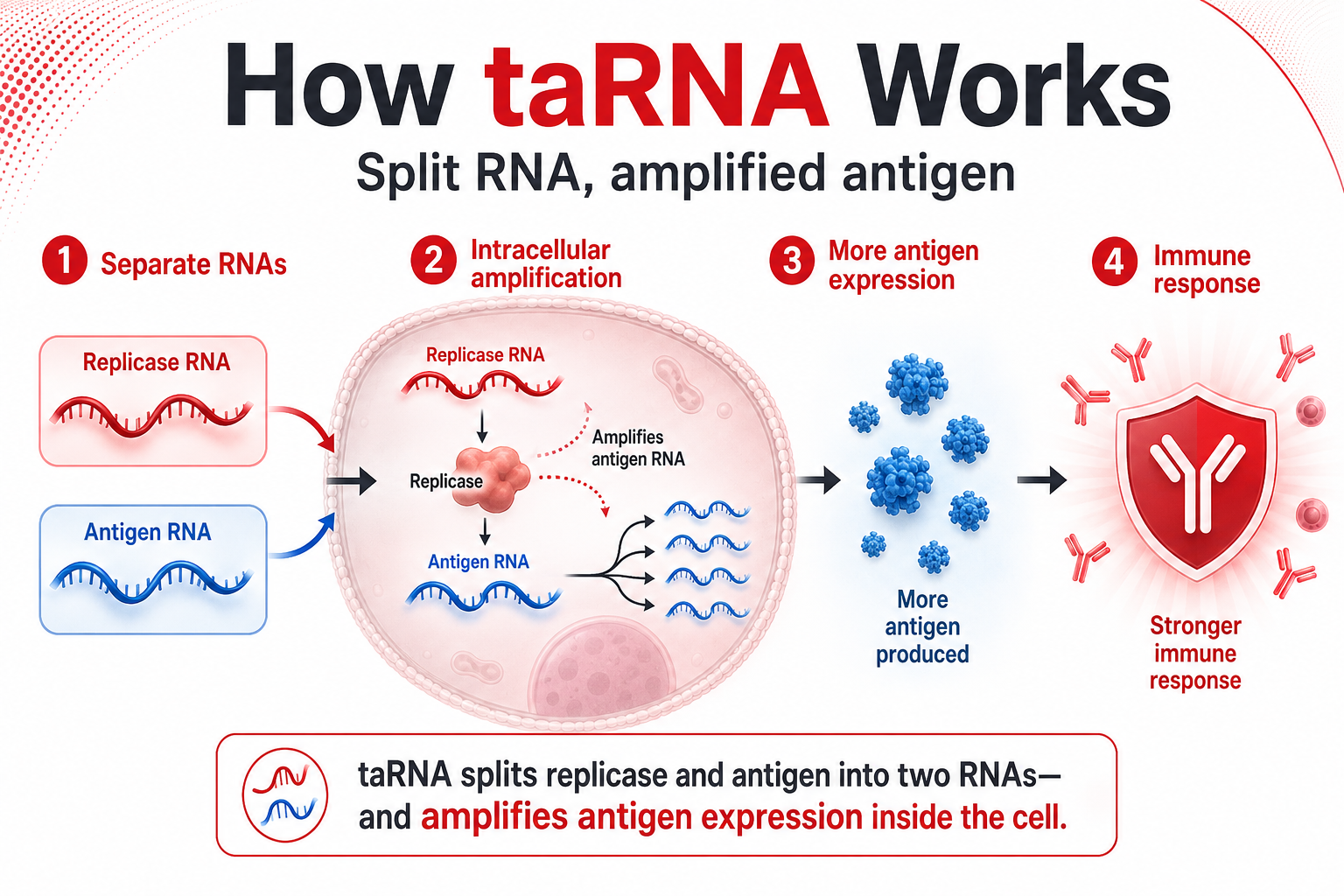
Why taRNA separates the replicase from the antigen payload — and how that differs from conventional mRNA and self-amplifying RNA.
Related Analysis
For the strategic and development context, read our main BP analysis: [Eli Lilly Moves Into Trans-Amplifying RNA Vaccines With Amplitude Deal]
Science at a Glance
| Item | Details |
|---|---|
| Technology | Trans-amplifying RNA (taRNA) |
| Developer | Amplitude Therapeutics |
| Partner | Eli Lilly |
| Indication | Infectious-disease vaccines |
| Core design | Replicase mRNA + antigen-encoding transreplicon |
| Biological function | Intracellular amplification of antigen RNA |
| Related platforms | mRNA, self-amplifying RNA (saRNA) |
| Development stage | Preclinical |
Amplitude Therapeutics and Eli Lilly are collaborating on taRNA vaccines for undisclosed infectious diseases, with Lilly retaining options for up to two additional targets. (Amplitude–Lilly collaboration)
From mRNA to RNA Amplification
Conventional mRNA delivers an RNA encoding the antigen. The cell translates that RNA into antigen protein, after which the RNA is gradually degraded.
mRNA
Antigen mRNA → antigen protein → immune response
Self-amplifying RNA, or saRNA, adds alphavirus-derived replicase genes to the same RNA molecule. Once translated, the replicase generates additional antigen-encoding RNA inside the cell.
saRNA
Replicase + antigen in one RNA
→ replicase production
→ RNA amplification
→ antigen production
The trade-off is size. saRNA is typically around 10 kb, largely because the replicase genes themselves occupy several kilobases, which can complicate production, stability and delivery. (saRNA and taRNA review)
How taRNA Splits the System
Trans-amplifying RNA takes the amplification concept of saRNA but divides it into two separate RNA molecules.
- Replicase mRNA → produces the replicase protein
- Antigen transreplicon → contains the antigen sequence and replication signals
The replicase then recognizes and amplifies the separate transreplicon inside the cytoplasm.
taRNA
Replicase mRNA → replicase protein
+
Antigen transreplicon → RNA amplification
→ antigen production
→ immune response
Unlike saRNA, the replicase-encoding RNA and antigen payload are physically separated. The replicase therefore acts in trans on the antigen-encoding transreplicon rather than being encoded on the same amplifying RNA molecule. (taRNA mechanism review)

mRNA vs saRNA vs taRNA
| Feature | mRNA | saRNA | taRNA |
|---|---|---|---|
| RNA molecules | 1 | 1 | 2 |
| Replicase | None | Same RNA as antigen | Separate RNA |
| Antigen RNA amplification | No | Yes | Yes |
| RNA architecture | Relatively short | Large | Split |
| Core strategy | Direct translation | Self-amplification | Trans-amplification |
The key difference is therefore not simply amplification. Both saRNA and taRNA amplify antigen RNA.
What distinguishes taRNA is that the amplification machinery is separated from the antigen payload, allowing the antigen transreplicon to remain much shorter than a full saRNA construct. This modular architecture could make antigen replacement and platform optimization more flexible. (taRNA platform architecture)
Why the Split Design Matters
The shorter antigen transreplicon creates an interesting development strategy: the replicase component could potentially remain relatively constant while different antigen transreplicons are produced for different vaccine targets.
Preclinical work illustrates the dose potential of this approach. In one mouse study, a taRNA system containing 20 μg of replicase mRNA and only 50 ng of antigen-coding transreplicon produced immune responses comparable to 20 μg of conventional antigen-encoding mRNA. This is promising, but it remains preclinical evidence rather than proof of a clinical dose advantage. (taRNA preclinical study)
The main trade-off is delivery: because taRNA uses two RNA molecules, both components must reach the appropriate cells for efficient trans-amplification.
BP Science View
taRNA is best understood as a split amplified-RNA system.
Its potential advantage is architectural rather than simply producing “more RNA.” By separating the replicase from the antigen payload, taRNA could make amplified RNA vaccines more modular and easier to adapt across different targets.
The remaining question is whether those preclinical advantages translate into better dose efficiency, manufacturing and clinical performance in humans. The Eli Lilly–Amplitude collaboration will be an important test of that concept.
About BP Science
BP Science explains the biology, mechanisms, modalities and technology landscapes behind emerging biopharma therapies.

Leave a Reply