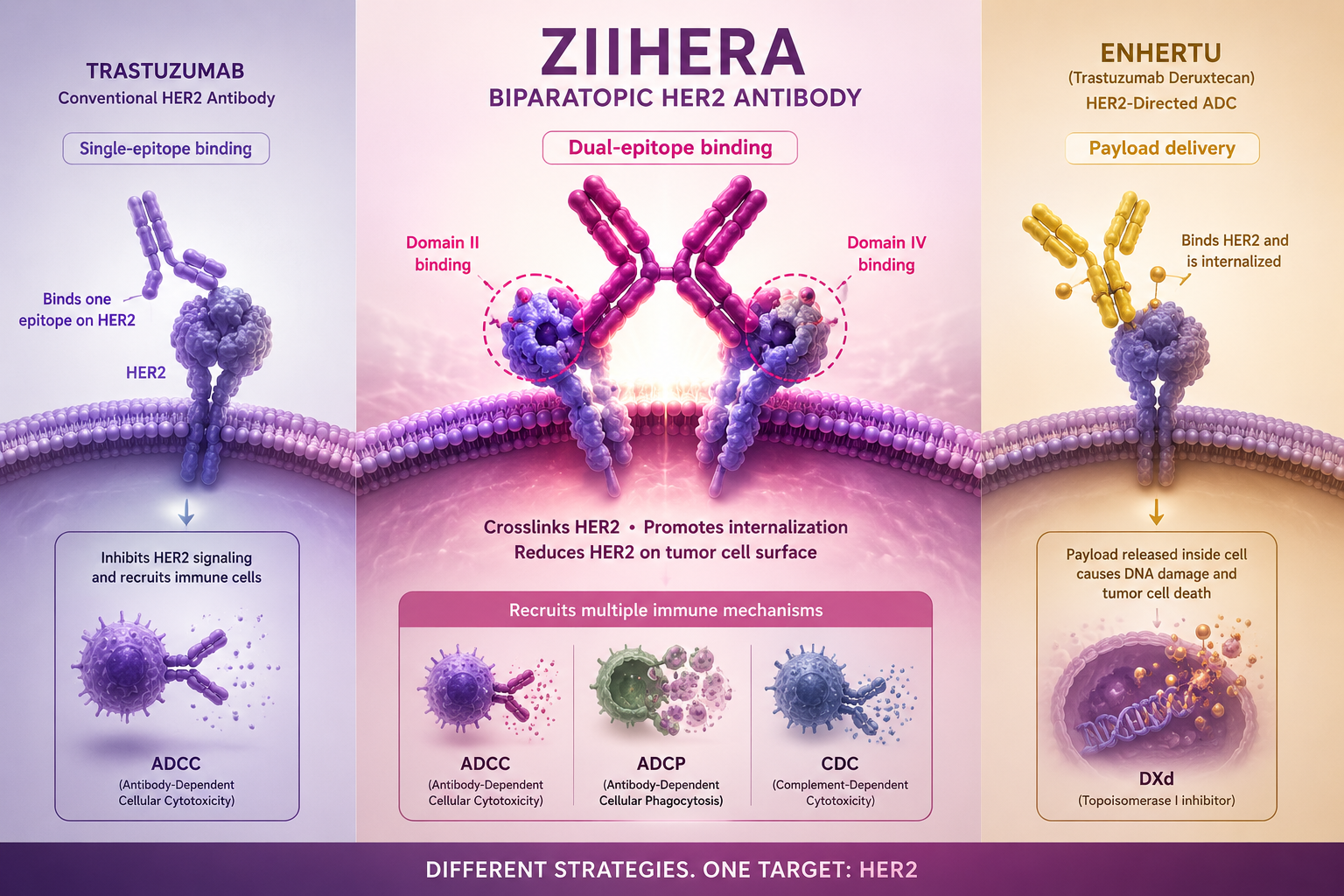
How Jazz Pharmaceuticals’ biparatopic HER2 antibody uses dual-site binding to drive receptor internalization and immune-mediated tumor killing.
Related Analysis
For the clinical and strategic context, read my main BP analysis: [Jazz Wins First-Line FDA Approval for Ziihera in HER2-Positive Gastroesophageal Cancer]
Science at a Glance
| Therapy | Modality | HER2 Strategy | Core Mechanism |
|---|---|---|---|
| Ziihera (zanidatamab) | Biparatopic bispecific antibody | Binds HER2 extracellular domains II and IV | Receptor clustering/internalization + immune-mediated killing |
| Trastuzumab | Monoclonal antibody | Binds one HER2 epitope | HER2 signaling inhibition + ADCC |
| Enhertu | HER2-directed antibody-drug conjugate (ADC) | HER2-targeted payload delivery | Internalization → DXd release → topoisomerase I inhibition |
Ziihera differs from trastuzumab because zanidatamab binds two distinct extracellular sites on HER2 simultaneously, while trastuzumab uses a single HER2-binding epitope. Enhertu takes another approach by coupling HER2 targeting to delivery of a cytotoxic payload.
1. Why HER2 Is a Drug Target
Human epidermal growth factor receptor 2 (HER2) is a receptor tyrosine kinase involved in signaling pathways that regulate cell proliferation and survival. HER2 overexpression can drive tumor growth, making the receptor an established target in multiple cancers.
HER2 therapies can attack this biology in different ways: by disrupting receptor signaling, recruiting immune cells, promoting receptor removal, or delivering cytotoxic drugs.
2. How Ziihera Works
Ziihera (zanidatamab) is a biparatopic HER2-directed bispecific antibody that binds HER2 extracellular domains II and IV on separate HER2 molecules.
This dual-site binding promotes HER2 internalization and reduces the amount of HER2 remaining on the tumor-cell surface. (Ziihera mechanism of action)

Ziihera also triggers several immune-mediated killing mechanisms, including antibody-dependent cellular cytotoxicity (ADCC), antibody-dependent cellular phagocytosis (ADCP) and complement-dependent cytotoxicity (CDC). (Ziihera prescribing information mechanism)
Simplified:
Ziihera → HER2 domains II + IV → receptor internalization ↓ surface HER2 + immune-mediated killing
3. How Is This Different From Trastuzumab?
Trastuzumab is a conventional HER2-targeted monoclonal antibody that inhibits proliferation of HER2-overexpressing tumor cells and mediates ADCC. (FDA Herceptin mechanism)
The key structural difference is simple:
Trastuzumab → one HER2 epitope
Ziihera → two HER2 extracellular domains
Ziihera therefore adds dual-site receptor crosslinking and stronger receptor internalization to mechanisms that overlap with conventional HER2 antibody therapy.
Whether that structural advantage consistently translates into superior clinical benefit will depend on tumor type and treatment setting.
4. Where Does Enhertu Fit?
Enhertu (trastuzumab deruxtecan) is a HER2-directed antibody-drug conjugate (ADC).
After binding HER2 and entering the tumor cell, its linker is cleaved and the DXd payload, a topoisomerase I inhibitor, is released to cause DNA damage and cell death.
So the three approaches can be summarized as:
- Trastuzumab: block HER2 signaling and recruit immune killing
- Ziihera: engage HER2 at two sites, promote receptor removal and recruit immune killing
- Enhertu: use HER2 targeting to deliver a potent intracellular cytotoxic payload
BP Science View
Ziihera is notable because its differentiation comes from how the antibody engages HER2 itself, rather than from adding a cytotoxic payload.
That places it between conventional HER2 antibodies and HER2-directed ADCs mechanistically. If dual-site binding continues to produce stronger receptor removal and effective immune-mediated killing across tumor types, Ziihera could establish a distinct therapeutic position within an increasingly crowded HER2 landscape.
About BP Science
BP Science explains the biology, mechanisms, modalities and technology landscapes behind emerging biopharma therapies.

Leave a Reply