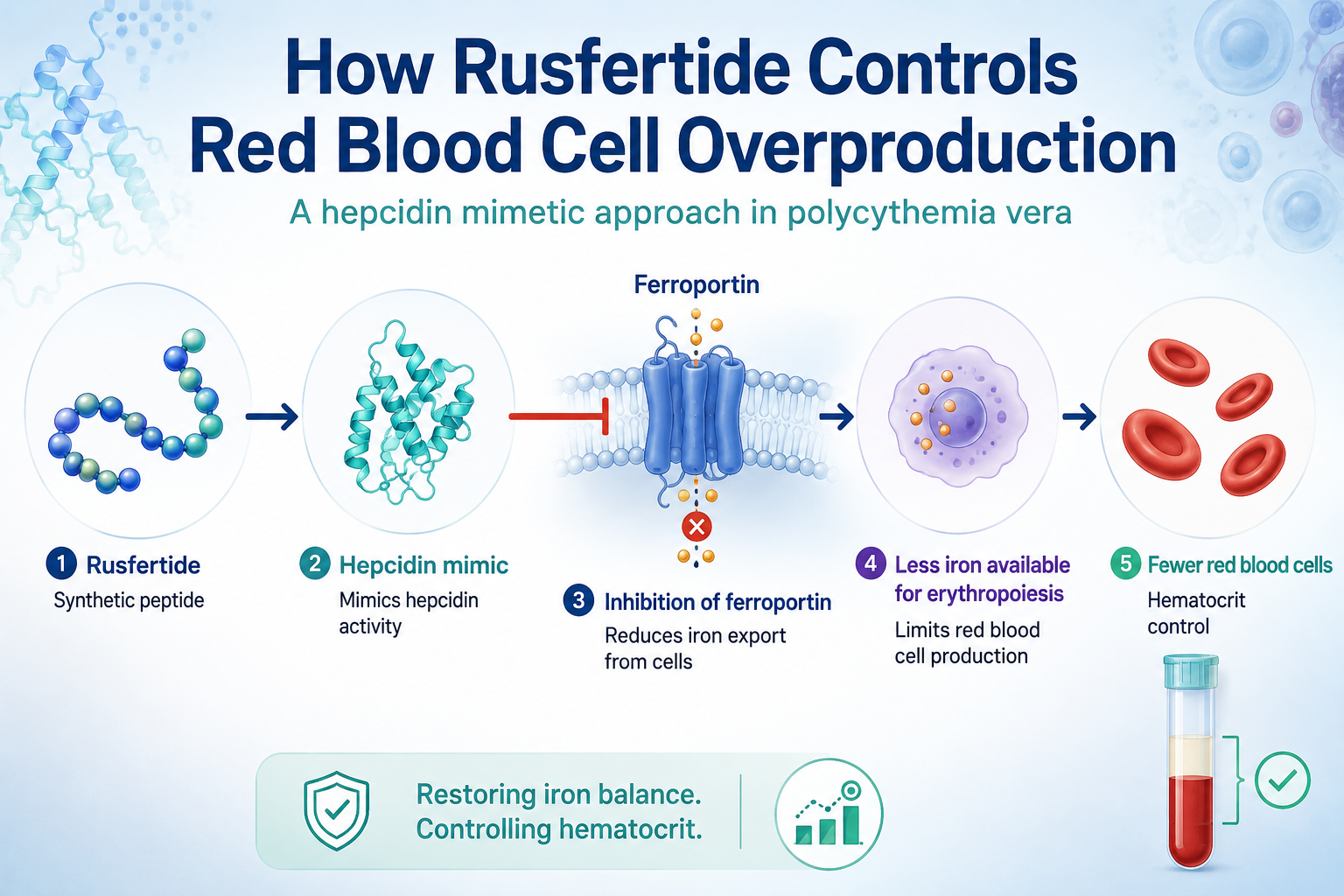
Mimrylo (rusfertide) mimics hepcidin to restrict iron availability for erythropoiesis, introducing a new way to control hematocrit in polycythemia vera.
Related Analysis
Want the news story behind this science? Read my analysis of Takeda’s FDA approval of Mimrylo for polycythemia vera.
Science at a Glance
Mimrylo (rusfertide) is a first-in-class hepcidin mimetic peptide approved by the FDA for the treatment of erythrocytosis in adults with polycythemia vera (PV). Rusfertide restricts the iron available for red blood cell production by mimicking the physiological activity of hepcidin. (FDA approval)
| Therapy | Developer | Modality | Iron-control mechanism | PV status |
|---|---|---|---|---|
| Rusfertide (Mimrylo) | Takeda / Protagonist Therapeutics | Hepcidin mimetic peptide | Mimics hepcidin → ferroportin-mediated iron export ↓ | FDA approved, 2026 |
| Sapablursen | Ionis / Ono | Antisense oligonucleotide | TMPRSS6 inhibition → endogenous hepcidin ↑ | Phase 2a positive |
| Divesiran (SLN124) | Silence Therapeutics | siRNA | TMPRSS6 silencing → endogenous hepcidin ↑ | Phase 2 positive; Phase 3 planned 1H 2027 |
The three programs use different modalities, but all ultimately aim to reduce iron availability for excessive erythropoiesis.
Why Polycythemia Vera Produces Too Many Red Blood Cells
Polycythemia vera is a chronic myeloproliferative neoplasm in which abnormal hematopoietic signaling drives excessive blood-cell production, particularly red blood cells.
The resulting increase in hematocrit raises blood viscosity and contributes to thrombosis and cardiovascular complications. Maintaining hematocrit below 45% is therefore a major treatment goal in PV. (CYTO-PV, NEJM)
Conventional treatment includes phlebotomy, which physically removes excess red blood cells, and cytoreductive therapies such as hydroxyurea, interferon and ruxolitinib.
Rusfertide takes a different approach: it limits the iron required to make new red blood cells.
How Rusfertide Mimics Hepcidin
Hepcidin is the body’s principal hormone for systemic iron regulation.
Its key target is ferroportin, the major cellular iron exporter found on intestinal enterocytes, macrophages and hepatocytes. Hepcidin binding reduces ferroportin activity and promotes its internalization, limiting iron release into the circulation. (Hepcidin–ferroportin axis)
Rusfertide reproduces this biological function.
Rusfertide
→ hepcidin mimetic activity
→ ferroportin-mediated iron export ↓
→ circulating iron availability ↓
→ iron available for erythropoiesis ↓
→ red blood cell production ↓
→ hematocrit control
Importantly, rusfertide does not primarily target the abnormal JAK2 signaling that drives PV. Instead, it restricts the iron supply required for continued excessive erythropoiesis.

Rusfertide mimics hepcidin to reduce ferroportin-mediated iron release, limiting the iron available for excessive red blood cell production.
Clinical Validation of Iron Restriction
The Phase 3 VERIFY trial enrolled 293 adults with PV who remained dependent on phlebotomy despite standard treatment.
Between Weeks 20 and 32, 76.9% of patients receiving rusfertide required no phlebotomy compared with 32.9% receiving placebo, demonstrating substantially improved hematocrit control. (VERIFY Phase 3)
Earlier Phase 2 REVIVE results also showed a randomized-withdrawal response rate of 60% with rusfertide versus 17% with placebo. (REVIVE, NEJM)
Together, these studies clinically validate the concept that restricting systemic iron availability can control excessive erythropoiesis in PV.
Emerging Iron-Control Strategies
Rusfertide is the first approved therapy in this emerging iron-control field, but competing programs are targeting the same biological axis from upstream.
Sapablursen is an antisense oligonucleotide that inhibits TMPRSS6, a negative regulator of hepcidin production. Phase 2a data showed increased hepcidin and reduced phlebotomy requirements in PV. (Sapablursen Phase 2a)
Divesiran (SLN124) uses siRNA to silence TMPRSS6. In the Phase 2 SANRECO trial, 88% of divesiran-treated patients achieved hematocrit control without phlebotomy versus 19% with placebo, and Silence Therapeutics plans to begin Phase 3 development in the first half of 2027. (SANRECO Phase 2)
The mechanistic difference is simple:
Rusfertide → directly mimics hepcidin
Sapablursen / Divesiran → inhibit TMPRSS6 → endogenous hepcidin ↑
Both approaches ultimately converge on:
ferroportin activity ↓ → iron availability ↓ → erythropoiesis ↓

Rusfertide directly mimics hepcidin, while sapablursen and divesiran increase endogenous hepcidin by targeting TMPRSS6.
BP Science View
Rusfertide is scientifically interesting because it controls a blood cancer-related phenotype without directly suppressing the oncogenic signaling pathway. Instead, it reduces iron availability, limiting a critical resource required for excessive red blood cell production.
The emergence of sapablursen and divesiran also suggests that the hepcidin–ferroportin axis is becoming a competitive therapeutic field. Rusfertide has first-mover advantage, while longer-acting RNA-based approaches could eventually compete on dosing convenience, hematocrit control and durability.
Ferroportin inhibition also has a theoretical connection to ferroptosis, because increased intracellular iron retention can increase susceptibility to iron-dependent lipid peroxidation in some cellular contexts. However, this should not be interpreted as evidence that rusfertide induces pathological ferroptosis in patients. Its established pharmacological action is systemic iron restriction to reduce erythropoiesis, and ferroptotic cell death has not been established as part of its therapeutic mechanism. (Ferroptosis biology)
About BP Science
BP Science explains the biology and mechanisms behind emerging biopharmaceutical technologies, connecting molecular science with clinical and competitive development.
Have a question about my interpretation or a different view on the science? Leave a comment — I’d be happy to discuss it.

Leave a Reply