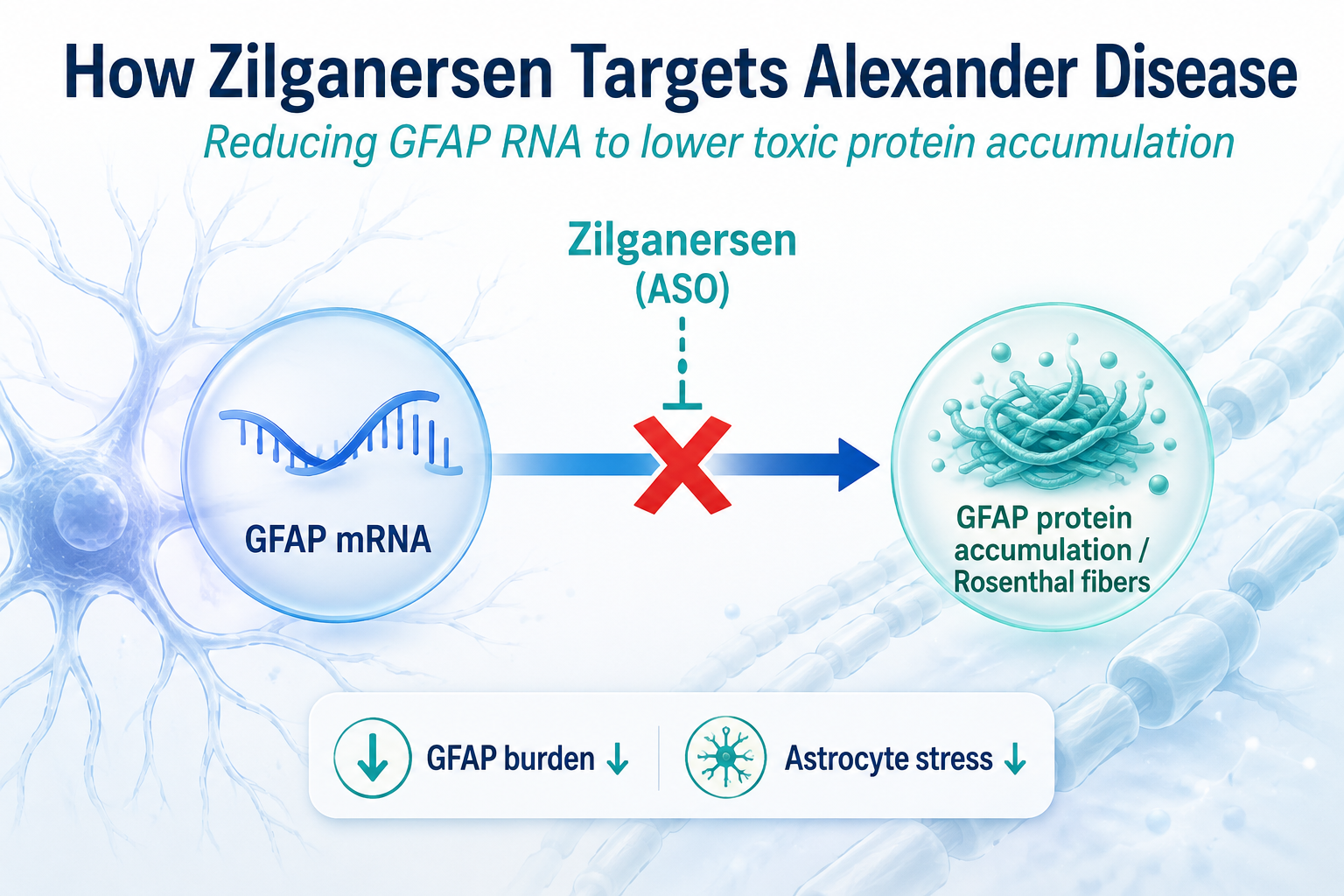
Zanvastro (zilganersen) is an antisense oligonucleotide that lowers GFAP production upstream of the toxic protein accumulation that drives Alexander disease.
Related Analysis
Want the news story behind this science? Read my analysis of the FDA approval of Zanvastro as the first treatment for Alexander disease.
Science at a Glance
Zanvastro (zilganersen) is an antisense oligonucleotide developed by Ionis Pharmaceuticals that targets GFAP RNA to reduce production of the disease-driving glial fibrillary acidic protein in Alexander disease. The FDA approved Zanvastro on September 3, 2026 for pediatric and adult patients, making it the first FDA-approved treatment for Alexander disease. (FDA approval)
| Item | Details |
|---|---|
| Drug | Zanvastro (zilganersen) |
| Company | Ionis Pharmaceuticals |
| Modality | Antisense oligonucleotide (ASO) |
| Molecular target | GFAP RNA |
| Mechanism | GFAP production and pathological GFAP accumulation ↓ |
| Disease | Alexander disease |
| Clinical evidence | Pivotal Phase 1–3 study |
| Regulatory status | FDA approved, September 3, 2026 |
| Administration | Intrathecal injection every 3 months |
The core therapeutic concept is:
GFAP RNA ↓ → GFAP protein production ↓ → pathological GFAP burden ↓ → astrocyte stress ↓
Why GFAP Drives Alexander Disease
Alexander disease is a rare neurological disorder caused by pathogenic GFAP variants that lead to abnormal GFAP accumulation in astrocytes and progressive nervous-system dysfunction. (FDA disease biology)
GFAP is a type III intermediate-filament protein that helps maintain the structural organization of astrocytes.
Under normal conditions:
GFAP gene → GFAP mRNA → normal GFAP protein → organized intermediate filaments → stable astrocyte function
In Alexander disease, pathogenic GFAP variants produce a predominantly toxic gain-of-function phenotype. GFAP accumulates within astrocytes and contributes to formation of Rosenthal fibers, characteristic protein aggregates containing GFAP together with stress-related proteins such as αB-crystallin and HSP27. (GFAP mechanism review)
What Happens After GFAP Accumulates?
GFAP is not a receptor or kinase, so Alexander disease does not follow a single linear signaling cascade.
Instead, abnormal GFAP accumulation activates several interconnected astrocyte stress responses, including:
JNK and p38 MAPK signaling ↑
proteostasis and proteasomal dysfunction
heat-shock responses ↑
altered autophagy
These changes contribute to progressive astrocyte dysfunction and impaired support of CNS white matter. (Alexander disease pathways)
The disease pathway can therefore be simplified as:
GFAP mutation
→ abnormal GFAP accumulation / Rosenthal fibers
→ JNK/p38 activation + proteostasis stress + altered autophagy
→ astrocyte dysfunction
→ white-matter injury
→ neurological dysfunction

Zilganersen intervenes upstream of pathological GFAP accumulation by reducing GFAP RNA, while downstream disease biology involves multiple astrocyte stress pathways rather than a single signaling axis.
How Zilganersen Interrupts the Disease
Zilganersen acts before excessive GFAP protein can accumulate.
Zilganersen targets GFAP RNA and reduces GFAP production, lowering the pathological protein burden that drives Alexander disease. (Ionis mechanism)
Mechanistically:
GFAP mutation
→ GFAP RNA
→ Zilganersen-mediated GFAP RNA reduction
→ GFAP protein production ↓
→ pathological GFAP accumulation ↓
→ astrocyte stress ↓
Zilganersen does not repair the underlying GFAP DNA mutation. Instead, it lowers production of the disease-driving protein downstream of that mutation.
This is why the FDA described Zanvastro as the first therapy to directly target the protein buildup responsible for Alexander disease.
Clinical Evidence Supports the Mechanism
Zilganersen was evaluated in a global, randomized, double-blind, controlled Phase 1–3 study (NCT04849741) that enrolled 54 participants aged 1.5 to 53 years across 13 sites in eight countries. (Phase 1–3 study)
The pivotal efficacy analysis focused on the 50 mg dose cohort.
At Week 61, zilganersen 50 mg produced a 33.3% least-squares mean difference versus control in the percent change from baseline in 10-Meter Walk Test gait speed (95% CI 1.4–65.3; p=0.0412). The zilganersen group showed an LSM change of −2.1%, compared with −35.4% in pooled controls, indicating stabilization rather than a simple 33.3% improvement in walking speed. (10MWT pivotal result)
The biomarker result aligned with the drug’s molecular mechanism.
Zilganersen reduced plasma GFAP by 33.6% versus control at Week 61 in an exploratory analysis (nominal p=0.003), providing evidence of target engagement consistent with GFAP RNA reduction. (GFAP biomarker)
The same study therefore showed both lower GFAP biomarker levels and stabilization of gait performance, supporting mechanistic alignment without proving that the biomarker reduction itself directly caused the functional benefit.
BP Science View
Zilganersen is a particularly clear example of why RNA-targeted therapy can be effective in a toxic protein-accumulation disorder.
Alexander disease is driven not by a simple absence of GFAP, but by excessive and abnormal GFAP burden within astrocytes. Zilganersen therefore acts relatively early in the disease process, reducing GFAP production before further protein accumulation, Rosenthal fiber formation and downstream astrocyte stress can occur.
The clinical data are notable because molecular and functional signals moved in the same direction. Zilganersen reduced plasma GFAP by 33.6% versus control while also stabilizing gait performance on the 10-Meter Walk Test at Week 61. (Ionis pivotal data)
For an ultra-rare neurological disorder that previously had no approved treatment, Zanvastro provides the first clinical validation that directly lowering GFAP production can be associated with measurable functional benefit in Alexander disease.
About BP Science
BP Science explains the biology and mechanisms behind emerging biopharmaceutical technologies, connecting molecular science with clinical and competitive development.
Have a question about my interpretation or another angle you’d like to discuss? Leave a comment — I’d be happy to hear your thoughts.

Leave a Reply