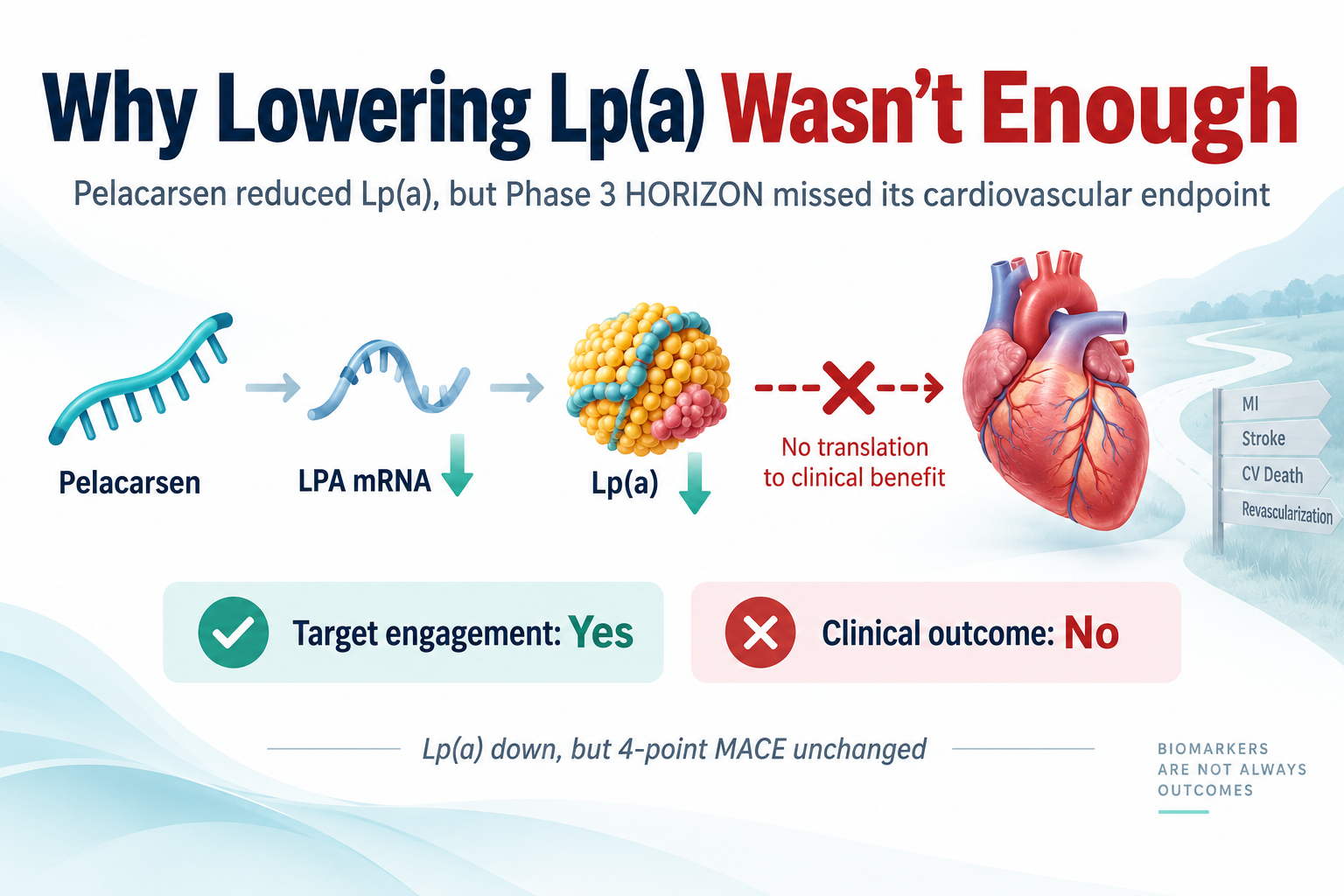
Pelacarsen successfully lowered lipoprotein(a), but the Phase 3 Lp(a)HORIZON trial showed that molecular target engagement did not translate into fewer major cardiovascular events.
Related Analysis
Want the news story behind this science? Read my analysis of Novartis and Ionis’ Phase 3 Lp(a)HORIZON failure.
Science at a Glance
Pelacarsen is a GalNAc-conjugated antisense oligonucleotide that targets LPA mRNA in hepatocytes, reducing apolipoprotein(a) synthesis and circulating lipoprotein(a) levels. GalNAc promotes delivery to liver cells, where apo(a) is produced. (Pelacarsen mechanism)
| Item | Details |
|---|---|
| Drug | Pelacarsen |
| Companies | Novartis / Ionis Pharmaceuticals |
| Modality | GalNAc-conjugated antisense oligonucleotide |
| Molecular target | LPA mRNA |
| Protein affected | Apolipoprotein(a), apo(a) |
| Biological effect | Lp(a) ↓ |
| Phase 3 trial | Lp(a)HORIZON |
| Participants | 8,323 |
| Population | Elevated Lp(a) + established cardiovascular disease |
| Primary endpoint | 4-point MACE |
| Result | Primary endpoint not met |
The biological hypothesis was:
LPA mRNA ↓ → apo(a) ↓ → Lp(a) ↓ → cardiovascular risk ↓
The Phase 3 trial showed that the final step was not clinically demonstrated.
What Is Lp(a)?
Lipoprotein(a), or Lp(a), is an apoB-100-containing lipoprotein particle with an additional apolipoprotein(a), or apo(a), covalently attached.
The LPA gene encodes apo(a).
So:
LPA gene
→ LPA mRNA
→ apo(a)
→ apo(a) attaches to an apoB-100-containing LDL-like particle
→ Lp(a)
Lp(a) is not simply another form of LDL. Elevated Lp(a) is a strongly genetically determined and causal risk factor for atherosclerotic cardiovascular disease, with biological effects linked to atherogenesis, inflammation and thrombosis. (Lp(a) biology)
How Pelacarsen Was Expected to Work
Pelacarsen acts upstream of Lp(a) formation.
Its antisense sequence binds complementary LPA mRNA, promoting RNA degradation and reducing translation of apo(a).
Mechanistically:
Pelacarsen
→ LPA mRNA ↓
→ apo(a) production ↓
→ Lp(a) formation ↓
The expected downstream effect was:
Lp(a) ↓
→ oxidized phospholipid burden ↓
→ arterial inflammation / atherosclerotic activity ↓
→ thrombosis-related risk ↓
→ 4-point MACE ↓

Pelacarsen achieved the upstream biological goal of lowering Lp(a), but the expected downstream reduction in major cardiovascular events did not occur.
What Did Lp(a)HORIZON Actually Test?
The Phase 3 Lp(a)HORIZON trial enrolled 8,323 patients with elevated Lp(a) and established cardiovascular disease.
Its primary endpoint was 4-point major adverse cardiovascular events (MACE):
- cardiovascular death
- non-fatal myocardial infarction
- non-fatal stroke
- urgent coronary revascularization requiring hospitalization
The study therefore did not simply ask:
“Can pelacarsen lower Lp(a)?”
It asked the more important question:
“Does lowering Lp(a) reduce major cardiovascular events?”
Pelacarsen lowered Lp(a), but Lp(a)HORIZON did not demonstrate a statistically significant reduction in the primary cardiovascular endpoint versus placebo. Detailed numerical outcome data have not yet been fully presented, so interpretation should remain limited to the topline result. (HORIZON result – Reuters)
Why Could the Biology and Clinical Outcome Diverge?
The result does not establish that Lp(a) is merely a biomarker or that its causal relationship with cardiovascular disease is wrong.
Instead, several mechanistic explanations remain possible.
1. Treatment may have started too late
HORIZON was a secondary-prevention trial. Participants already had established cardiovascular disease.
Once advanced plaque, vascular remodeling and tissue injury are present, reducing one upstream risk factor may not fully reverse the existing disease burden.
2. Lifelong exposure is different from several years of treatment
Genetic evidence reflects the effect of decades of Lp(a) exposure.
Drug therapy lowers Lp(a) for a much shorter period. A causal relationship over a lifetime does not necessarily mean that late pharmacological intervention will rapidly reverse risk.
3. Residual cardiovascular risk remains
Lp(a) is only one component of cardiovascular biology.
Even after lowering Lp(a), risk can persist through:
LDL-C + hypertension + diabetes + inflammation + existing plaque instability + other thrombotic pathways
HORIZON therefore tested whether Lp(a) lowering alone was sufficient in patients already receiving contemporary cardiovascular therapy—and the topline result suggests it was not sufficient in this setting. Fierce Biotech had highlighted this issue before the readout, noting that improved background cardiovascular care and lower overall event rates could make incremental benefit harder to demonstrate. (HORIZON context – Fiercebiotech)
BP Science View
The key scientific lesson from Lp(a)HORIZON is not that Lp(a) is irrelevant. It is that molecular target engagement and clinical outcome validation are different levels of evidence.
Pelacarsen engaged its intended pathway:
LPA mRNA ↓ → apo(a) ↓ → Lp(a) ↓
But the expected downstream step:
Lp(a) ↓ → 4-point MACE ↓
was not demonstrated.
That leaves several mechanistic questions open: Was treatment initiated too late? Was the duration too short? Is deeper Lp(a) suppression required? Or does cardiovascular benefit depend on a specific patient population or biological context?
In my view, this is what makes HORIZON scientifically important. Pelacarsen validated Lp(a) as a druggable biological target, but it did not validate Lp(a) lowering as a sufficient clinical-outcome strategy in this Phase 3 population.
About BP Science
BP Science explains the biology and mechanisms behind emerging biopharmaceutical technologies, connecting molecular science with clinical and competitive development.
Have a question about my interpretation or another angle you’d like to discuss? Leave a comment — I’d be happy to hear your thoughts.

Leave a Reply