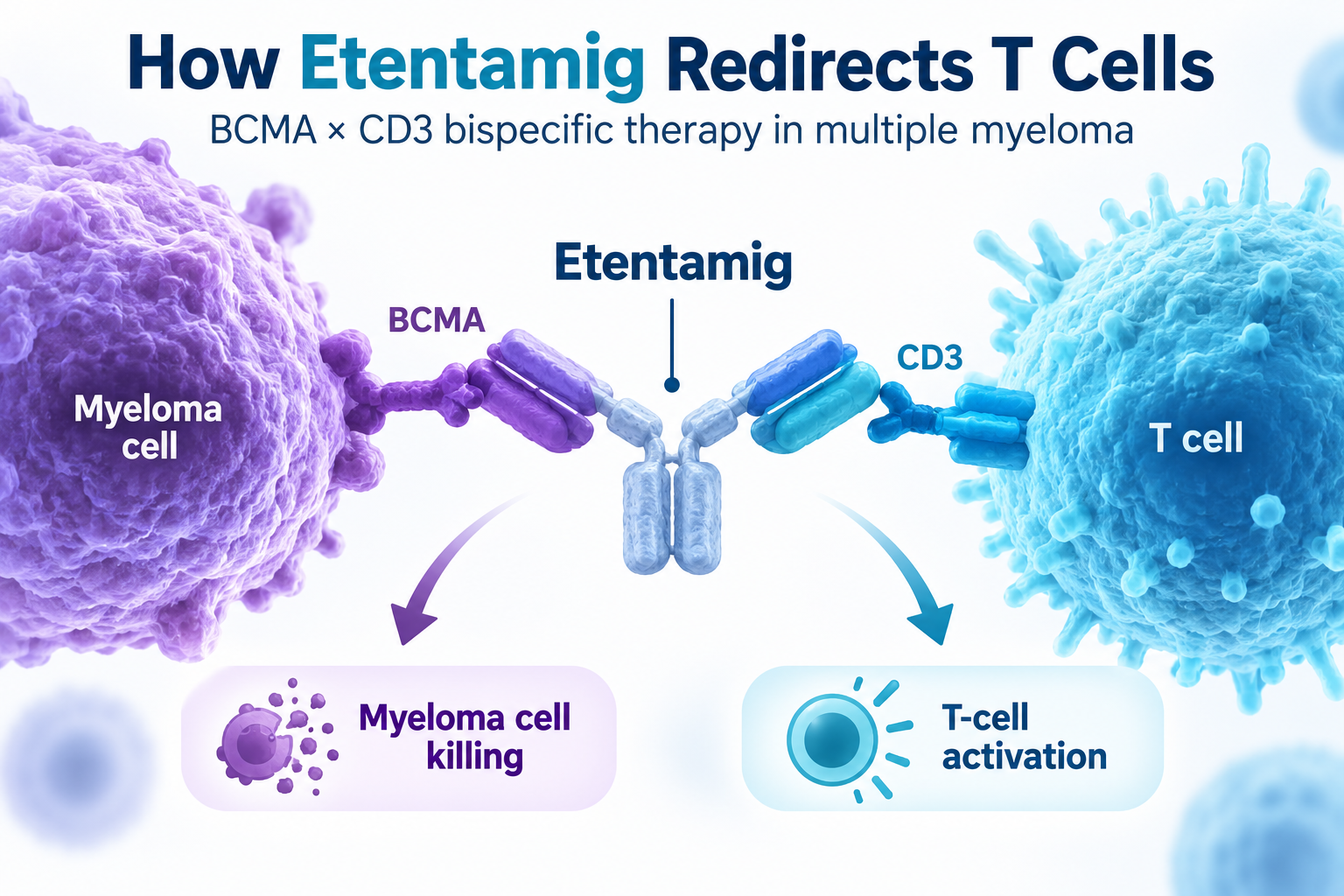
AbbVie’s BCMA × CD3 bispecific uses bivalent tumor binding and deliberately low-affinity CD3 engagement to redirect T cells against myeloma cells.
Related Analysis
Want the news story behind this science? Read my analysis of AbbVie’s Phase 3 CERVINO results for etentamig.
Science at a Glance
Etentamig (ABBV-383) is an investigational BCMA × CD3 bispecific T-cell engager that physically links BCMA-positive myeloma cells with CD3-positive T cells, triggering redirected T-cell cytotoxicity against the tumor.
Unlike a conventional symmetric antibody design, etentamig combines bivalent, high-avidity BCMA binding with a low-affinity CD3-binding domain. Its Fc region is functionally silenced while retaining FcRn-mediated recycling, a design intended to preserve exposure without adding unwanted Fc effector activity. (Phase 1 molecular design)
| Item | Details |
|---|---|
| Candidate | Etentamig (ABBV-383) |
| Company | AbbVie |
| Modality | BCMA × CD3 bispecific T-cell engager |
| Tumor target | BCMA |
| Immune target | CD3 |
| BCMA architecture | Bivalent, high-avidity binding |
| CD3 architecture | Low-affinity binding |
| Fc feature | Silenced Fc with retained FcRn binding |
| Development stage | Phase 3 |
| Phase 3 regimen | Single step-up dose followed by Q4W dosing |
The core biology can be summarized as:
BCMA × CD3 bridging → T-cell activation → perforin/granzyme release → myeloma-cell apoptosis
Why BCMA Works as a Myeloma Target
B-cell maturation antigen (BCMA; TNFRSF17/CD269) is a member of the tumor necrosis factor receptor family and is expressed predominantly on plasmablasts and plasma cells.
Its expression is particularly relevant in multiple myeloma because malignant plasma cells commonly express high levels of surface BCMA, whereas most non-hematologic tissues show little or no meaningful BCMA expression.
BCMA also contributes to plasma-cell survival through signaling initiated by its ligands APRIL and BAFF, which can activate pathways including NF-κB, MAPK and AKT. This restricted expression pattern and biological importance have made BCMA one of the central immunotherapy targets in multiple myeloma. (BCMA biology review)
Etentamig uses that surface antigen as a docking point rather than attempting to kill the myeloma cell directly.
The other side of the antibody binds CD3, part of the T-cell receptor complex.
By bringing those two cells into close proximity, the bispecific effectively redirects a T cell toward a target it may not otherwise recognize through its native antigen receptor.
How Etentamig Activates a T Cell
Once etentamig simultaneously engages BCMA and CD3, CD3-associated signaling initiates a T-cell activation program.
At the protein level, an important signaling sequence involves:
CD3 → ZAP70 → LAT / SLP76 → PLCγ1
PLCγ1 activation then feeds into downstream signaling including:
Ca²⁺ → NFAT
and
MAPK activation
Together, these pathways promote T-cell activation, cytokine production and deployment of cytotoxic machinery.
The important point is that etentamig provides the physical bridge that initiates this redirected immune synapse. The downstream killing machinery belongs to the T cell itself.

Etentamig redirects CD3-positive T cells toward BCMA-positive myeloma cells, initiating intracellular T-cell signaling before cytotoxic effector molecules are released toward the tumor.
What Happens After T-Cell Activation?
T-cell activation is only the beginning of the antitumor response.
Activated cytotoxic T cells release granules containing perforin and granzymes into the immune synapse.
Perforin facilitates pore formation in the target-cell membrane, while granzymes gain access to the myeloma-cell cytoplasm. Intracellular granzyme activity can then activate caspase-dependent apoptotic pathways, ultimately driving programmed cell death.
The sequence is therefore:
T-cell activation → perforin/granzyme release → granzyme entry → caspase activation → myeloma-cell apoptosis
Activated T cells also release inflammatory cytokines, including IFN-γ and TNF-α. These signals contribute to antitumor immune activity, but excessive T-cell activation and cytokine release are also central to the biology of cytokine release syndrome (CRS) seen with T-cell-engaging therapies. (Bispecific antibody review)
What Is Different About Etentamig’s Design?
The broad mechanism—BCMA-directed T-cell redirection—is shared by other bispecific antibodies.
Etentamig’s differentiation lies in how the antibody is engineered to control that interaction.
Bivalent BCMA Binding
Etentamig contains two BCMA-binding domains, giving the antibody high-avidity interaction with BCMA-expressing myeloma cells.
This differs from several BCMA × CD3 bispecifics that use monovalent BCMA binding.
The design is intended to maintain strong tumor-cell engagement even while the CD3 side of the molecule is deliberately tuned to interact more weakly with T cells.
Low-Affinity CD3 Binding
Etentamig’s CD3-binding domain has relatively low affinity; the first-in-human publication reported a CD3 affinity of approximately 1.3 μM.
That is an intentional engineering choice rather than a limitation.
Preclinical work suggests that lower-affinity CD3 engagement can maintain redirected tumor killing while reducing cytokine release and limiting excessive T-cell stimulation. Etentamig’s combination of bivalent BCMA engagement and low-affinity CD3 binding was also associated with more sustained T-cell activation and reduced exhaustion signals in preclinical models. (Etentamig preclinical design study)
Retained FcRn Binding
Etentamig uses an Fc region engineered to reduce unwanted immune-effector activity while retaining binding to the neonatal Fc receptor (FcRn).
FcRn rescues IgG antibodies from lysosomal degradation and returns them to circulation, contributing to longer antibody persistence.
For etentamig, that pharmacokinetic design supports the rationale for less frequent treatment.
In the Phase 3 CERVINO study, etentamig was given with a single step-up dose followed by once-every-four-weeks dosing from treatment initiation. The study included 393 patients, and topline results showed an objective response rate of 74.0% versus 45.7% with standard available therapies and a 60% reduction in the risk of progression or death (PFS HR 0.40; 95% CI 0.29–0.54). (AbbVie CERVINO topline results)
Those efficacy results support etentamig’s clinical potential, although they do not by themselves prove that its molecular architecture caused the observed efficacy or safety profile.
BP Science View
Etentamig is interesting because the underlying therapeutic idea is no longer new.
BCMA-directed T-cell redirection is already clinically validated in multiple myeloma. The scientific question has shifted toward whether the interaction between tumor cell, antibody and T cell can be engineered more precisely.
Etentamig takes that approach at several levels. Its bivalent BCMA arm emphasizes strong tumor engagement, while its low-affinity CD3 arm deliberately avoids maximizing T-cell binding strength. The retained FcRn interaction then adds a pharmacokinetic component that can support a longer dosing interval.
That makes the molecule less about discovering another immune pathway and more about tuning an established mechanism.
The Phase 3 CERVINO result is therefore notable not only because etentamig improved response and progression-free survival, but because it suggests that a BCMA × CD3 bispecific built around binding geometry, controlled CD3 engagement and longer exposure can remain competitive in an increasingly crowded myeloma market.
The next question is whether those design choices translate into a genuinely differentiated balance of efficacy, CRS burden, infection risk and treatment convenience when the full Phase 3 dataset is presented.
About BP Science
BP Science explains the biology and mechanisms behind emerging biopharmaceutical technologies, connecting molecular science with clinical and competitive development.
Have a question about my interpretation or another angle you’d like to discuss? Leave a comment — I’d be happy to hear your thoughts.

Leave a Reply