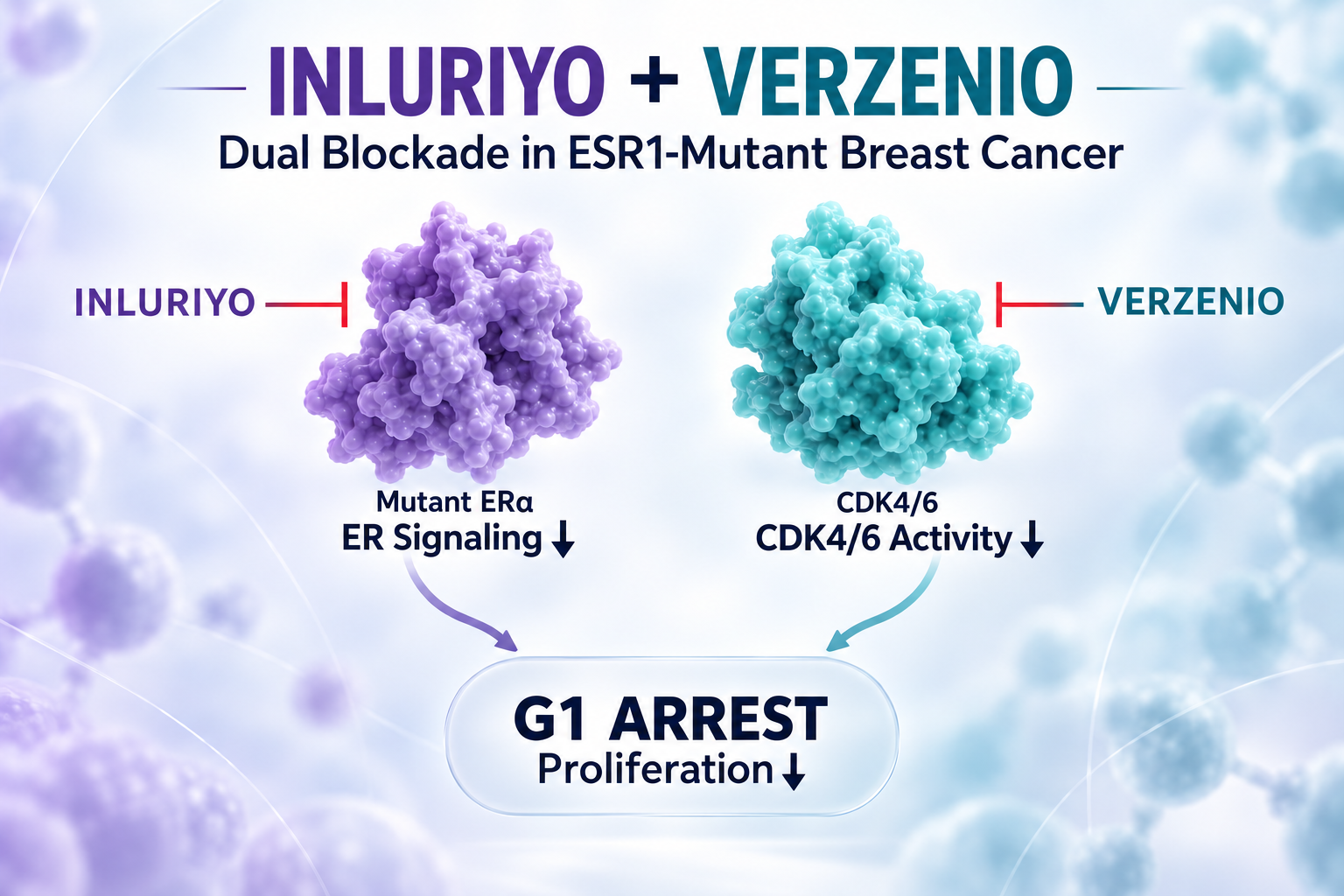
Imlunestrant suppresses mutant ERα, while abemaciclib blocks the downstream CDK4/6–RB–E2F cell-cycle pathway.
Related Analysis
Want the news story behind this science? Read my analysis of Eli Lilly’s Inluriyo–Verzenio Combination Wins FDA Approval in ESR1-Mutated Breast Cancer.
Science at a Glance
| Treatment | Mechanism | Treatment setting |
|---|---|---|
| Inluriyo + Verzenio | ERα antagonism and degradation + CDK4/6 inhibition | After progression on endocrine therapy |
| Orserdu | Oral SERD monotherapy | Post-progression ESR1-mutated disease |
| Veppanu | PROTAC-mediated ERα degradation | Post-progression ESR1-mutated disease |
| Etcamah + CDK4/6 inhibitor | Oral SERD + continued CDK4/6 inhibition | ESR1 mutation detected before radiographic progression |
Inluriyo and Verzenio suppress the upstream resistance driver and the downstream cell-cycle machinery within the same proliferative pathway.
How the Dual Blockade Works
Estrogen receptor alpha, or ERα, is encoded by the ESR1 gene. Activated ERα promotes the transcription of genes supporting tumor-cell growth, including signals feeding into the cyclin D1–CDK4/6 pathway.
Aromatase inhibitors reduce estrogen production, but prolonged treatment can select ESR1 ligand-binding-domain mutations such as Y537S and D538G. These mutations stabilize an active ERα conformation, allowing transcription to continue even when estrogen is scarce. This creates acquired resistance to estrogen deprivation. (ESR1 mutation study)
Inluriyo (imlunestrant) binds ERα, antagonizes its transcriptional activity and induces receptor degradation. Reducing the cellular ERα pool limits persistent signaling from the mutant receptor.
Inluriyo is a selective estrogen receptor degrader, not a proteolysis-targeting chimera, or PROTAC. Its mechanism should not be depicted as direct recruitment of an E3 ubiquitin ligase.
Verzenio (abemaciclib) acts further downstream. Cyclin D1–CDK4/6 normally phosphorylates the retinoblastoma protein, or RB. Phosphorylated RB releases E2F, which activates DNA-replication genes and allows progression from G1 into S phase.
Abemaciclib inhibits CDK4/6 and reduces RB phosphorylation. RB therefore remains associated with E2F, producing G1 cell-cycle arrest and reduced tumor-cell proliferation.
The complete mechanism is:
ESR1-mutant ERα → ER-dependent transcription → cyclin D1–CDK4/6 → RB phosphorylation → E2F release → G1-to-S progression
Inluriyo + Verzenio → mutant ERα signaling ↓ + CDK4/6 activity ↓ → RB–E2F maintained → G1 arrest → tumor-cell proliferation ↓
The combination is best described as complementary dual blockade, rather than proven pharmacologic synergy. The approved dosages are Inluriyo 400 mg orally once daily on an empty stomach and Verzenio 150 mg orally twice daily. (Inluriyo prescribing information, Verzenio prescribing information)

What EMBER-3 Demonstrated
EMBER-3 evaluated imlunestrant alone, standard endocrine therapy and imlunestrant plus abemaciclib in previously treated ER-positive, HER2-negative advanced breast cancer.
In an exploratory analysis of 159 patients with ESR1-mutated disease, the combination produced a median progression-free survival of 11.1 months, compared with 5.5 months for imlunestrant alone. The hazard ratio was 0.53, indicating a 47% lower hazard of progression or death during the analysis period. Objective response rates were 35% and 15%, respectively. (EMBER-3 trial)
Overall survival remained immature. In addition, 79% of the subgroup had previously received a CDK4/6 inhibitor, but only 6% of previously exposed patients had received abemaciclib. The evidence therefore supports switching from another CDK4/6 inhibitor to abemaciclib more strongly than abemaciclib retreatment.
The added pathway blockade also increased treatment burden. Diarrhea occurred in 86% of combination-treated patients, making tolerability and dose management relevant to real-world use.
How the Competitors Differ
Orserdu (elacestrant) and Veppanu (vepdegestrant) compete directly in post-progression ESR1-mutated disease. Orserdu is an oral SERD, while Veppanu is a PROTAC that recruits an E3 ligase to promote ubiquitin-mediated ERα degradation. (Veppanu FDA approval)
Etcamah (camizestrant) uses a different treatment strategy. When an ESR1 mutation appears in circulating tumor DNA before radiographic progression, the aromatase inhibitor is replaced by Etcamah while the same CDK4/6 inhibitor is continued. It is therefore an earlier molecular-interception approach rather than a direct post-progression comparison. (SERENA-6 trial)
BP Science View
Inluriyo targets the acquired ESR1 resistance mechanism, while Verzenio prevents the remaining signal from driving cell-cycle progression. The combination therefore connects a defined resistance driver with the downstream machinery that executes proliferation.
The next question is no longer limited to which ER degrader should be used. Treatment selection will increasingly depend on when an ESR1 mutation is detected and whether CDK4/6 inhibition should be continued, switched or reintroduced.
About BP Science
BP Science explains the biology behind major biotechnology and pharmaceutical developments, connecting molecular mechanisms with clinical evidence and competitive strategy.

Leave a Reply